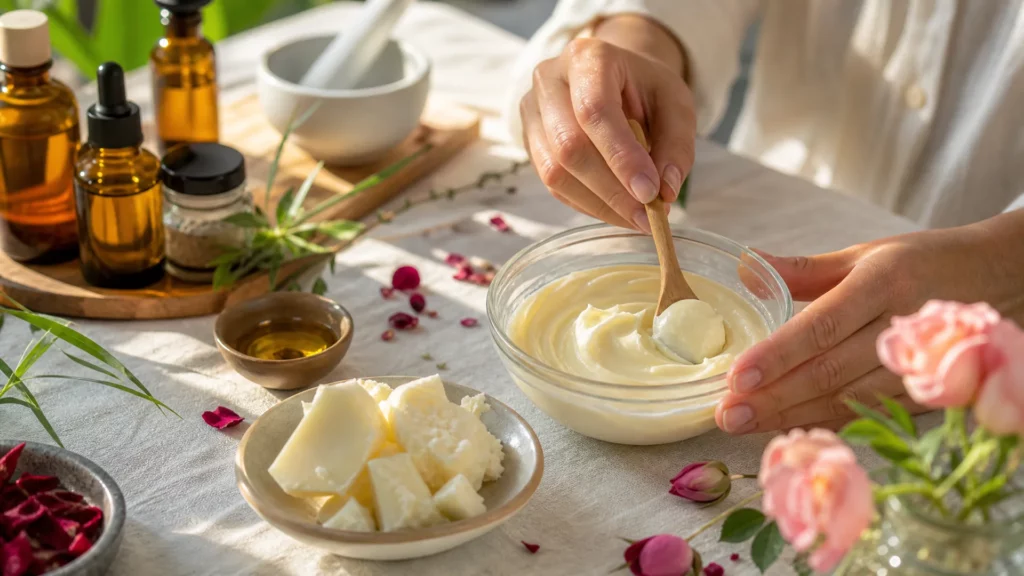
How to Make Natural Face Cream at Home
Learning how to make natural face cream at home is one of the most rewarding steps you can take in DIY natural skincare. You choose every ingredient, you know exactly what goes on your skin, and you can tailor the formula to your skin type, all for a fraction of the price of premium store-bought creams. If you’re based in South Africa, there’s the added bonus of being able to source everything locally, fresh, and at cosmetic grade. This guide walks you through the building blocks, the best oils to use, a simple beginner recipe, and exactly where to find your ingredients.
Why Make Your Own Natural Face Cream?
Store-bought moisturisers often contain synthetic stabilisers, fillers, and preservative cocktails that you may not want on your face every day. When you make your own, you control every single ingredient, no compromise.
There’s also a real cost argument. A good-quality handmade batch of face cream, made with well-sourced ingredients, works out significantly cheaper per gram than most natural skincare brands at the pharmacy. And because you make it fresh in small batches, you’re not getting a product that’s been sitting on a shelf for two years.
For South African makers, local sourcing used to be the sticking point. That barrier is much smaller now.
What Goes Into a Natural Face Cream: The Four Building Blocks
A face cream isn’t just oil rubbed into skin. It’s an emulsion, a stable blend of water and oil that absorbs easily and delivers both hydration and moisture. To make one, you need four things working together.
Carrier oils and butters, the moisturising base
These form your oil phase. They nourish and soften skin, create a protective barrier, and carry any fat-soluble actives you want to include. Shea butter, sweet almond oil, and jojoba oil are all classic choices.
Emulsifiers, what holds water and oil together
Oil and water don’t mix on their own, anyone who’s tried to shake a salad dressing knows that. An emulsifier acts as the go-between: it has one end that bonds with water and one that bonds with oil, pulling them into a stable, creamy blend. Without an emulsifier, your cream will separate into a greasy puddle within hours. Olive M1000 is a beginner-friendly option and widely used in natural cosmetic formulation.
Water phase, hydration from the inside out
This is usually distilled water, aloe vera juice, or a blend of both. The water phase makes up the bulk of most face creams and gives the finished product its light, spreadable texture. It also carries water-soluble ingredients like glycerin, which pulls moisture into the skin.
Preservatives and cosmetic actives, keeping it safe and effective
This is non-negotiable: any product that contains water can support microbial growth, bacteria, mould, and yeast, within days without a preservative. Experienced formulators consistently recommend using a broad-spectrum preservative even in small home batches, regardless of how natural your other ingredients are. Preservatives like Saliguard BDHA or Euxyl K712 are widely used in natural formulation and are available at cosmetic grade. Optional actives, such as niacinamide, vitamin E, or rosehip oil, go into a cool-down phase added after the emulsion has formed.
The Best Oils for Face Cream: Choosing the Right Carrier Oils
The carrier oils you choose will shape how your cream feels, how well it absorbs, and how it performs for your skin type. Here are the most versatile options for beginners.
Lightweight oils for everyday moisturising
Sweet almond oil is a go-to starter oil. It’s light, absorbs well, suits most skin types, and has a mild, neutral scent. It’s rich in oleic and linoleic acid, making it genuinely nourishing without feeling heavy.
Jojoba oil is technically a liquid wax rather than a true oil, which makes it uniquely resistant to oxidation. It has an exceptionally long shelf life compared with most carrier oils and suits nearly every skin type, including oily and acne-prone skin, because its structure closely resembles the skin’s own sebum. It’s one of the most recommended starter oils in DIY natural skincare for good reason.
Apricot kernel oil is another lightweight option, very similar to sweet almond but with a slightly finer texture. It works well for sensitive and mature skin.
Richer oils and butters for dry or mature skin
Shea butter is the workhorse of natural skincare. It’s rich in fatty acids and has a creamy texture that melts beautifully into an emulsion. Use it at 5–15% in a face cream, any more and the formula can feel heavy.
Rosehip seed oil is rich in linoleic acid and naturally occurring vitamin A precursors, making it popular for maturing, scarred, or uneven-toned skin. It’s best added in the cool-down phase, below 40 °C, to preserve its active fatty acid profile, heat degrades it quickly.
Mango butter is another excellent richer option: silky, non-greasy, and packed with fatty acids that support the skin barrier. It pairs well with lighter oils to balance out the texture.
All of these carrier oils for face cream are stocked at DIY Naturally, so you can order everything you need in a single local delivery.
Simple Natural Face Cream Recipe (Step-by-Step)
This beginner formula follows a standard oil-in-water emulsion structure. A basic face cream typically uses a 70–75% water phase, a 20–25% oil phase, and around 3–5% emulsifier, this ratio is the backbone of most stable emulsions and a reliable starting point for first-time formulators.
What you’ll need
Equipment:
- Digital kitchen scale (accurate to 0.1 g)
- Two heat-safe glass jugs or beakers
- Double boiler or microwave
- Stick blender
- Sanitised spatulas
- Small glass or plastic jars with lids
Ingredients (makes approx. 100 g):
| Ingredient | % | Weight |
|---|---|---|
| Distilled water | 65% | 65 g |
| Aloe vera juice | 8% | 8 g |
| Glycerin | 3% | 3 g |
| Sweet almond or jojoba oil | 10% | 10 g |
| Shea butter | 8% | 8 g |
| Olive M1000 | 4% | 4 g |
| Broad-spectrum preservative | 1% | 1 g |
| Rosehip seed oil (optional active) | 1% | 1 g |
Method
-
Sanitise everything. Wipe all equipment with isopropyl alcohol and let it air dry. Clean equipment is your first line of defence against contamination.
-
Prepare your water phase. Combine distilled water, aloe vera juice, and glycerin in one heat-safe jug. Heat to 70–75 °C.
-
Prepare your oil phase. Combine sweet almond (or jojoba) oil, shea butter, and Olive M1000 in a second jug. Heat to 70–75 °C until the wax and butter have fully melted.
-
Combine the phases. Slowly pour the water phase into the oil phase while blending with a stick blender. Blend continuously for 2–3 minutes until the mixture turns white and creamy.
-
Cool down. Keep stirring as the emulsion cools. When the temperature drops below 40 °C, add your preservative and any optional actives like rosehip seed oil. Stir well to incorporate.
-
Jar and label. Transfer to sanitised jars, seal, and label with the date. Stored in a cool, dark place, this cream will keep for around 3 months.
Where to Source Your Homemade Face Cream Ingredients in South Africa
This is where most beginner formulations/guides fall short. They’ll tell you what to use but not where to find it, and tracking down cosmetic-grade ingredients in South Africa used to mean piecing together orders from multiple suppliers, paying steep shipping, or settling for food-grade ingredients that aren’t formulated for skin.
DIY Naturally stocks everything you need to make your first batch: carrier oils, shea and mango butter, emulsifying wax, glycerin, aloe vera juice, broad-spectrum preservatives, and glass and plastic jars for packaging. Everything is cosmetic grade and available for delivery across South Africa.
If you want to get started without picking individual items, browse the beginner skincare ingredient bundles, they’re a quick way to get everything in one order and take the guesswork out of sourcing.
Tips for Getting Your DIY Face Moisturiser Right Every Time
A few habits separate a stable, professional-feeling cream from a greasy or separated mess.
Always work by weight, not volume. Measuring oils and waters in millilitres gives inconsistent results. Use a digital scale and work in percentages, that way you can scale your recipe up or down accurately.
Match your temperatures. Both your water phase and oil phase must reach the same temperature (70–75 °C) before you combine them. Adding a cool water phase to a hot oil phase causes the emulsion to fail.
Use a stick blender. A hand whisk won’t create a stable emulsion consistently. A stick blender creates the shear force needed to break oil droplets down finely and blend them evenly into the water phase.
Keep heat away from your preservative. Add your preservative in the cool-down phase, not earlier, heat can reduce its effectiveness.
Make small test batches first. A 100 g batch is enough to evaluate texture, absorption, and skin feel before you scale up. Tweak one variable at a time so you can track what changes.
Making your own natural face cream recipe is genuinely achievable on a first attempt when you have the right ingredients and a reliable formula. Head to diynaturally.co.za to browse carrier oils, butters, emulsifiers, and preservatives, and get your first batch on the way.