Carrot Seed Oil, Essential Oil Vs Carrier Oil, Benefits for Skincare
If you’ve gone looking for carrot seed oil and come back more confused than when you started, you’re not alone. Search the name and you’ll find two very different products sitting side by side, one a pale, pungent essential oil sold in a tiny brown bottle, the other a rich, amber-hued carrier oil. Both come from Daucus carota. Both are genuinely useful in skincare. But they are not interchangeable, and mixing them up in a formula can cause real problems. This guide on carrot seed oil, essential oil vs carrier oil, benefits for skincare will untangle everything so you can shop, blend, and formulate with confidence.
Two Very Different Oils Share the Same Name
The confusion is understandable. The carrot plant (Daucus carota) produces seeds that can be processed in two completely different ways, steam distillation or cold pressing, and each method yields a chemically distinct product with different properties, different usage rules, and a different role in your formula.
Carrot seed essential oil is volatile, highly concentrated, and aromatic. Carrot seed carrier oil is fatty, nourishing, and can be applied directly to skin in much higher amounts. Think of them as distant cousins rather than the same ingredient in different sizes. Once you see the distinction, it becomes obvious, and it’s the foundation of getting your formula right.
Carrot Seed Essential Oil: What It Is and How It Works
How it’s made and what’s in it
Carrot seed essential oil is produced by steam distilling the dried seeds of Daucus carota (wild carrot). Steam passes through the plant material, the volatile aromatic compounds vaporise, and the resulting condensate separates into hydrosol and essential oil. The yield is small, which is part of why essential oils are expensive relative to their volume.
The key active constituents are carotol (its dominant sesquiterpene alcohol) and daucene, along with a range of other terpene compounds. Carotol in particular has attracted interest in cosmetic chemistry for its antioxidant activity. The aroma is warm, earthy, and slightly woody, distinctive rather than universally loved, but highly effective in small amounts as part of a blend.
Skincare benefits of carrot seed essential oil
Carrot seed essential oil has a strong reputation in anti-ageing and complexion-evening formulas. Its antioxidant profile helps neutralise free radicals that contribute to visible skin ageing. It’s also noted for its toning effect, helping to improve the appearance of uneven skin tone and dull complexions over time.
Because it’s so concentrated, a little goes a long way. It must always be diluted before skin application, its concentrated carotol content makes it potent, and a usage rate of 0.5–1% in a finished blend is standard practice to avoid sensitisation. Applied neat, it’s too strong for skin and should never be used that way.
Carrot Seed Carrier Oil: What It Is and How It Works
How it’s made and what’s in it
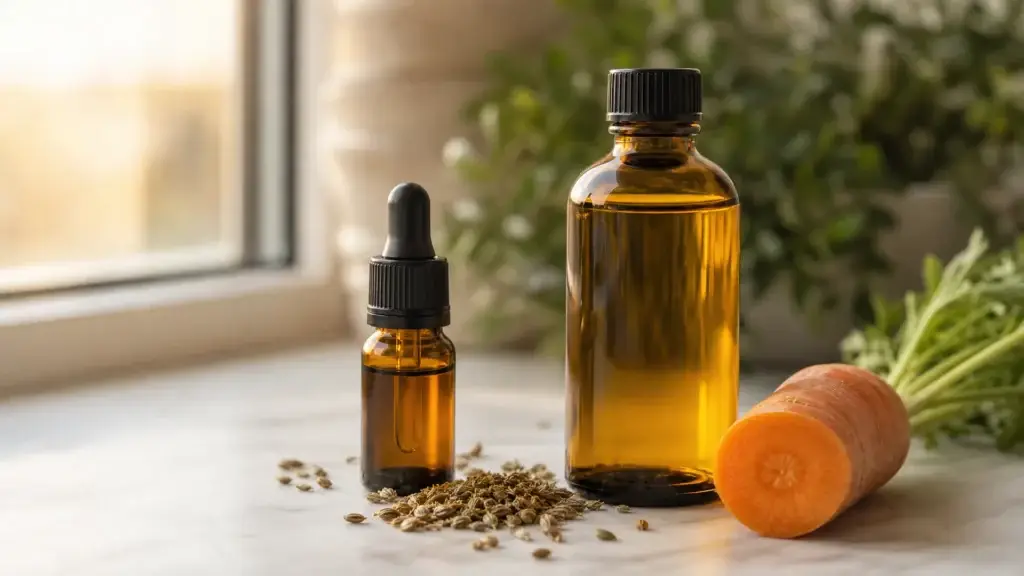
Carrot seed carrier oil (sometimes labelled wild carrot oil or Daucus carota seed oil) is produced by cold pressing carrot seeds. Cold pressing extracts the fatty oil mechanically, without heat, preserving its nutrient content. The result is a thick, deeply pigmented oil with a warm orange-amber colour, that colour comes directly from its exceptionally high beta-carotene content.
Beyond beta-carotene, carrot seed carrier oil is rich in vitamin E (tocopherols) and a broad spectrum of fatty acids including oleic and linoleic acid. These components make it genuinely nourishing rather than simply surface-conditioning. It has almost no aroma compared to the essential oil, perhaps a faint earthy note, nothing more.
Skincare benefits of carrot seed carrier oil
Carrot seed carrier oil is particularly well suited to dry, mature, and sun-stressed skin. Its beta-carotene is the same pigment responsible for the orange colour of carrots, and it contributes meaningful antioxidant activity in a formula, protecting skin from oxidative stress while supporting a more even-looking complexion.
The vitamin E content makes it a strong partner for how vitamin E oil works in skincare, reinforcing the antioxidant layer in any formula. Its fatty acid profile supports the skin barrier, helping skin retain moisture and feel more supple. It’s a heavier oil, so it’s often blended with lighter carriers like jojoba or squalane rather than used on its own, but it absolutely can function as a standalone base for very dry or mature skin types that welcome a richer texture.
Carrot seed carrier oil is frequently used alongside rosehip and marula oils in mature or sun-damaged skin formulas. Its carotenoid richness complements the skin-renewing reputation of those oils, making it a natural fit for that ingredient category. Browse the full carrier oils range to see how it sits alongside these complementary options.
Essential Oil vs Carrier Oil: The Key Differences at a Glance
Here’s a quick side-by-side to make the distinction concrete:
| Carrot Seed Essential Oil | Carrot Seed Carrier Oil | |
|---|---|---|
| Extraction | Steam distillation | Cold pressing |
| Key compounds | Carotol, daucene (volatile terpenes) | Beta-carotene, vitamin E, fatty acids |
| Concentration | Highly concentrated, used in drops | Nourishing base oil, used in grams/ml |
| Usage rate | 0.5–1% in a finished blend | 5–20% (or up to 100% in rich formulas) |
| Aroma | Strong, warm, earthy | Very mild to almost none |
| Role in formula | Active aromatic ingredient | Base/carrier for actives |
| Price per ml | Higher (small volume, low yield) | Lower (larger volumes standard) |
| Colour in formula | Minimal impact at dilution | Adds a warm orange tint at higher use |
The essential oil is your potent, aromatic active. The carrier oil is your nourishing base. Neither replaces the other.
How to Use Carrot Seed Oils in Your DIY Skincare Formulas
Blending the essential oil safely
Because carrot seed essential oil is used at 0.5–1%, you’re working with very small amounts, typically 3–6 drops per 30ml of finished product. The easiest starting point for beginners is a roller bottle blend: combine your chosen carrier oil (jojoba works beautifully here, light, non-comedogenic, and nearly odourless, so it lets the essential oil’s aroma come through), add your carrot seed essential oil at the lower end of the range, and roll onto pulse points or use as a targeted face treatment.
For a full face oil blend, pair carrot seed essential oil with complementary carriers like rosehip or jojoba. Keep your total essential oil load at 1% or under, if you’re blending two or three essential oils together, the combined total should stay within that limit. These essential oil roller bottle blend recipes give you ready-to-follow starting points.
Incorporating the carrier oil into serums and creams
Carrot seed carrier oil works well at 5–20% in face serums and creams. Below 5%, you won’t get much of its nourishing benefit. Above 20%, the texture becomes quite heavy for most skin types and the orange tint becomes noticeable in the finished product, which isn’t necessarily a problem, but worth knowing.
A practical example: a face serum using 10% carrot seed carrier oil (for nourishment), 85% jojoba (as a light base), and 0.5% carrot seed essential oil (for its active properties) shows how the two can work together in a single formula. The carrier oil does the heavy nutritive work; the essential oil contributes antioxidant actives and aroma in concentrated form.
For emulsions and creams, carrot seed carrier oil fits well into the oil phase alongside other nourishing oils. See how to make a natural face cream at home for a full walkthrough. If you’re newer to formulating generally, the beginner’s guide to skincare formulation gives you the foundational context before you dive into specific ingredients. And for a deep dive on jojoba as a blending partner, the jojoba oil formulation guide is worth bookmarking.
Which One Do You Actually Need?
Here’s the simple version:
- Want a potent, aromatic active that brings antioxidant and toning benefits in small, precise drops? → Carrot seed essential oil.
- Want a deeply nourishing base oil rich in beta-carotene, vitamin E, and skin-barrier-supporting fatty acids? → Carrot seed carrier oil.
- Want both? Many experienced formulators keep both on hand and use them together, as the face serum example above shows.
If you’re just starting out, pick the one that matches your immediate goal and keep it simple. A single carrier oil and one or two well-chosen essential oils is all you need for your first formula. As your confidence grows, you’ll naturally start layering ingredients.
At DIY Naturally, we stock both carrot seed carrier oil and carrot seed essential oil, along with complementary ingredients like jojoba, rosehip, and vitamin E, so you can source everything for a complete carrot seed formula in one place, whether you’re making your first roller blend or building out a small product range.
Disclaimer: All recipes and formulas are shared in good faith. DIY Naturally is not liable for any adverse reactions. Always perform a patch test before use, and substitute ingredients if you have known allergies. Use at your own discretion.