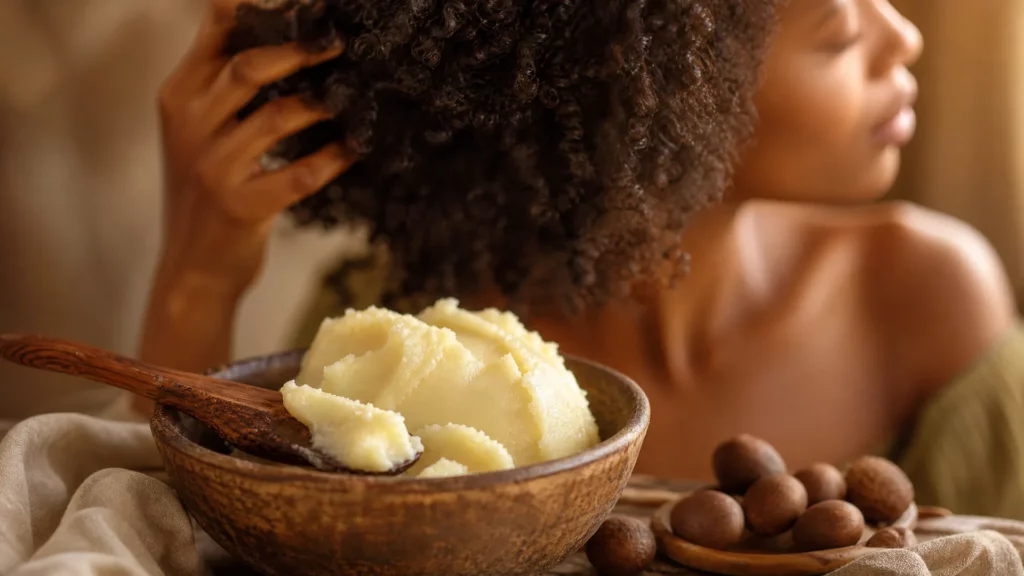
Shea Butter Benefits for Hair – DIY Recipes and Formulation Guide
Shea butter has been a hair care staple for generations across West and Central Africa, and for good reason. If you’re formulating your own hair products, understanding the shea butter benefits for hair goes well beyond “it’s moisturising.” This guide gets into the actual chemistry, the right ratios, and complete recipes, so you can make products that genuinely work, not just feel nice for five minutes.
Why Shea Butter Belongs in Your Hair Care Routine
Shea butter comes from the fat extracted from the nuts of the Vitellaria paradoxa (shea) tree. What makes it so effective for hair is its fatty acid profile. It’s rich in:
- Oleic acid (omega-9), penetrates the hair shaft, helping to soften and condition from within
- Stearic acid, coats the cuticle, sealing in moisture and adding smoothness
- Linoleic acid (omega-6), supports a healthy scalp and helps reinforce the lipid barrier
That dual action, shaft penetration and cuticle coating, is what sets shea butter apart. The oleic acid goes in; the stearic acid seals the surface. Most single-oil alternatives do one or the other, not both.
The result in practice: softer, shinier hair with noticeably reduced breakage and frizz. For natural, curly, and coily hair types, which are especially prone to moisture loss, shea is a formulation anchor, not an optional extra.
What Makes Shea Butter Different from Other Butters
Compared to cocoa butter, shea is lower in palmitic acid and richer in oleic acid, which makes it less occlusive and more readily absorbed. Mango butter is lighter but lacks shea’s protective stearic fraction. Kokum butter is harder and more brittle at room temperature, making it trickier to blend without heating.
Shea sits in a sweet spot: rich enough to deliver serious moisture, but workable enough to blend into a wide range of formulations, masks, leave-ins, curl creams, and oil blends. If you’re new to DIY hair products, the beginner’s guide to natural formulation is a useful starting point before you start weighing ingredients.
Raw vs Refined Shea Butter for Hair: Which One Should You Use?
This is one of the most common questions in natural formulation, and the answer depends entirely on what you’re making.
Raw (unrefined) shea butter is processed minimally, typically just pressed, filtered, and solidified. It retains its full fatty acid profile, plus vitamins A and E and a range of phytonutrients. It has a distinctive nutty, smoky scent and an off-white to yellowish colour. For deeply nourishing rinse-off masks and treatments where you want maximum actives, raw is the better choice.
Refined shea butter has been bleached, deodorised, and further filtered. It’s white, nearly odourless, and has a smoother texture. Some beneficial compounds are reduced in processing, but it’s much easier to work with when you want a clean-smelling, pale product, like a leave-in conditioner or a lightly scented styling cream.
How Processing Affects Performance in Hair Recipes
In a deep conditioning mask you’re washing out after 20–30 minutes, the extra nutrients in raw shea butter are worth having. The scent won’t matter once you rinse.
In a leave-in conditioner or curl cream that stays on your hair all day, refined shea is often the smarter pick. The scent of raw shea can clash with fragrance or essential oils, and the slightly lighter texture of refined shea blends more smoothly into emulsions.
DIY Naturally stocks both raw and refined shea butter, giving South African formulators the choice of grade best suited to their recipe, from rich rinse-off masks to lightweight leave-ins.
Shea Butter Percentage in Recipes: Getting Your Ratios Right
Usage rate is where a lot of DIY makers go wrong. More shea isn’t always better, especially in leave-in products.
Here are the general guidelines to work from:
| Product type | Recommended shea butter % |
|---|---|
| Rinse-off deep conditioning mask | 30–60% |
| Styling balm or curl cream | 10–25% |
| Leave-in conditioner | 5–15% |
| Hair oil blend | 10–20% (melted in) |
Shea Butter in Rinse-Off Masks vs Leave-In Conditioners
In a rinse-off mask, you have room to be generous. At 30–60%, shea delivers intense moisture and slip. Because you’re washing it out, there’s no build-up risk, you get all the conditioning benefit without the weight staying on your hair.
In a leave-in conditioner, the rules change. Keep butter content below 15% to avoid product build-up and greasiness. Above that threshold, especially on fine hair, you’ll get a coated, weighed-down feel that no amount of rubbing in will fix.
For styling balms and curl creams, you have more flexibility because these are used in smaller amounts and applied to specific sections. Aim for 10–25% depending on the hair type you’re targeting: higher for thick, coily hair; lower for wavy or finer textures.
Best Shea Butter Oil Blends for Hair
Shea butter on its own is heavy. Blending it with the right carrier oils thins it to a workable consistency, adds complementary benefits, and makes it far easier to distribute through the hair.
Pairing Shea Butter with Carrier Oils for Frizzy Hair
Here’s what each oil brings to a shea-based blend:
- Argan oil, lightweight, high in oleic and linoleic acid, adds shine and tames frizz without greasiness. Excellent for natural alternatives to silicones in hair products.
- Jojoba oil, technically a liquid wax, closely mimics the scalp’s sebum. Adds slip and helps the blend absorb without residue. The jojoba oil formulation guide explains why it’s such a versatile base ingredient.
- Castor oil, thick and high in ricinoleic acid, adds hold and dramatically improves slip through thick or coily hair. Adding castor at 5–10% to a shea butter hair mask helps the blend distribute evenly, a combination popular in South African natural hair communities.
- Sweet almond oil, lightweight, softening, high in oleic acid. Balances out heavier ingredients and absorbs quickly.
Browse the full range of carrier oils available at DIY Naturally to source everything for the blend below.
A Simple Shea Butter Hair Oil Blend Recipe
This is a pre-shampoo or overnight treatment blend. It’s anhydrous (no water), so no preservative is needed.
Total batch: 100g
| Ingredient | Weight | % |
|---|---|---|
| Refined shea butter (melted) | 20g | 20% |
| Jojoba oil | 30g | 30% |
| Sweet almond oil | 30g | 30% |
| Argan oil | 15g | 15% |
| Castor oil | 5g | 5% |
Method: Gently melt the shea butter over a double boiler. Remove from heat, add all liquid oils, stir to combine. Pour into a glass jar. Allow to cool and set slightly before use, it will be a soft, pourable consistency at room temperature.
Adding vitamin E oil to your DIY blend at 0.5–1% acts as an antioxidant and extends shelf life.
DIY Shea Butter Hair Mask Recipe (Step-by-Step)
Deep Conditioning Mask for Dry or Damaged Hair
This anhydrous mask is generous with shea and designed for 20–30 minutes under a shower cap before rinsing.
Total batch: 100g
| Ingredient | Weight | % |
|---|---|---|
| Raw shea butter | 50g | 50% |
| Castor oil | 10g | 10% |
| Sweet almond oil | 20g | 20% |
| Argan oil | 15g | 15% |
| Jojoba oil | 5g | 5% |
Method:
- Melt shea butter in a double boiler until just liquid. Do not overheat.
- Remove from heat. Add all carrier oils and stir well.
- Optional: add 5 drops of an essential oil of choice (rosemary, lavender) per 100g batch.
- Pour into a clean, wide-mouth jar. Allow to cool completely before sealing.
- Apply a generous layer to dry or damp hair from mid-length to ends. Avoid the scalp if you’re prone to build-up. Cover with a shower cap for 20–30 minutes, then shampoo out.
Storage & shelf life: Store in a cool, dark place. Because this is anhydrous (no water), it will keep for 9–12 months. No preservative is required for water-free formulations.
Frizz-Control Leave-In Conditioner Recipe
This recipe uses shea at a lower percentage for an all-day leave-in. It’s a shea butter for frizzy hair staple.
Total batch: 100g
| Ingredient | Weight | % |
|---|---|---|
| Refined shea butter (melted) | 10g | 10% |
| Jojoba oil | 15g | 15% |
| Sweet almond oil | 70g | 70% |
| Vitamin E oil | 1g | 1% |
| Essential oil (optional) | 4 drops | , |
Method:
- Melt shea butter and allow to cool slightly.
- Add jojoba, sweet almond oil, and vitamin E. Stir to fully combine.
- Add essential oil if using. Pour into a pump or squeeze bottle.
- Apply a small amount (pea to hazelnut sized) to damp hair after washing. Work through from mid-lengths to ends.
This is an anhydrous leave-in, so no preservative is needed. If you want to add a water or aloe vera phase to this recipe, you’ll need to read up on when and how to add a preservative, water in any formulation creates a microbial risk that vitamin E alone won’t address.
Storage & shelf life: Up to 12 months in a cool, dark location. A pump bottle reduces oxidation from repeated exposure to air.
Sourcing & Storing Shea Butter for DIY Hair Products
Quality matters more than most people realise. When buying shea butter, look for:
- Colour: Raw shea should be off-white to ivory or pale yellow, not bright white (that’s refined) and not grey or streaky (a sign of poor storage or old stock).
- Scent: Raw shea has a distinctive nutty scent. If it smells rancid or musty, don’t use it. Refined shea should be nearly odourless.
- Texture: At South African room temperatures (around 18–28°C), quality shea should be semi-solid to firm, not oily or greasy at room temperature, which can indicate adulteration.
How to store shea butter at home:
- Keep it in a cool, dark place, away from direct sunlight and heat sources.
- Use an airtight container to prevent oxidation.
- A clean, dry spoon or spatula every time keeps contamination low.
- Properly stored, raw shea butter lasts 18–24 months; refined shea is similar.
For South African DIY makers, sourcing locally means fresher stock, no long customs delays, and the ability to buy in quantities that match your batch size, from small trial amounts up to larger bulk orders. DIY Naturally supplies both raw and refined shea butter alongside the carrier oils, vitamin E, and storage containers you need to put these recipes into practice. If you’re building out your formulation kit, it’s the most convenient place to source everything in one order.
The shea butter benefits for hair are real and well-documented in cosmetic chemistry. They only translate into great products, though, when you get the ratios, the grade, and the complementary ingredients right. Now you have the framework to do exactly that.
Disclaimer: All recipes and formulas are shared in good faith. DIY Naturally is not liable for any adverse reactions. Always perform a patch test before use, and substitute ingredients if you have known allergies. Use at your own discretion.