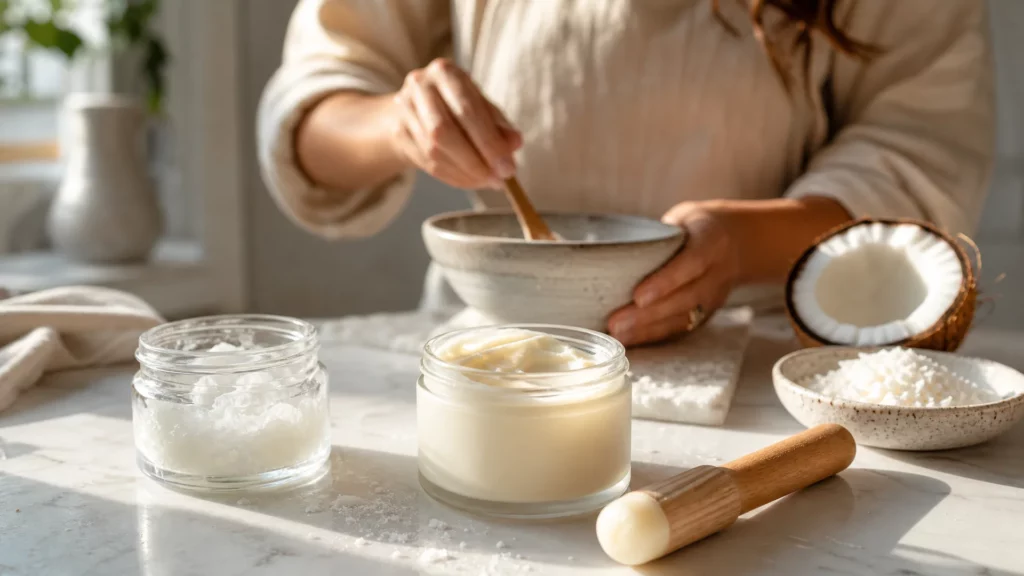
Natural Deodorant with Coconut Oil, Recipe & Troubleshooting Tips
A good natural deodorant recipe with coconut oil is one of the most satisfying things you can make from scratch. You control exactly what goes on your skin, it costs a fraction of the commercial alternatives, and the results, when the ratios are right, genuinely work. This guide gives you the exact formulas, explains what to do when things go wrong (sticky texture, graininess, staining), and covers the best containers for each format. Whether you’re a first-time maker or you’ve had a batch melt in the South African summer and want a fix, you’re in the right place.
If you’re completely new to formulating, the beginner’s guide to skincare formulation is a good starting point before diving in here.
Why Coconut Oil Is the Base of Choice for Natural Deodorant
Coconut oil brings three things to a deodorant formula: antimicrobial action, a skin-softening feel, and a melting point that sits right at body temperature (around 24–25°C).
The antimicrobial properties come from lauric acid, which makes up roughly 50% of coconut oil’s fatty acid profile. Body odour is caused by bacteria breaking down sweat, coconut oil helps slow that process directly at the skin surface.
Its melting point is both a feature and a challenge. At room temperature it gives a paste or stick a firm, spreadable texture. Applied to skin, it melts cleanly and absorbs without feeling greasy. In hot climates, though, that same low melting point means your formula can turn liquid in the jar, something the troubleshooting section below covers directly.
The Core Natural Deodorant Recipe: Ingredient Ratios That Actually Work
The classic coconut oil deodorant paste, roughly equal parts coconut oil, shea butter, arrowroot powder, and a smaller amount of baking soda, has been a staple of zero-waste beauty communities for years. The ratio holds up well for most skin types, and it’s the foundation both formulas below build from.
All ratios below are by weight, not volume. Use a digital scale.
Standard Paste Formula (the workhorse ratio)
This is the softest format. Apply with fingertips and store in a jar.
| Ingredient | % by weight |
|---|---|
| Coconut oil | 35% |
| Shea butter | 25% |
| Arrowroot powder | 28% |
| Baking soda (cosmetic grade) | 7% |
| Essential oils | 2% |
| Vitamin E (optional preservative) | 0.5–1% |
Melt the coconut oil and shea butter together over a bain-marie. Remove from heat, stir in the arrowroot powder and baking soda until smooth, add your essential oils, then pour into jars and allow to cool without stirring, stirring during cooling can cause graininess.
Note for South African makers: In summer heat above 28°C, this paste softens significantly. Increase arrowroot to 33% and reduce coconut oil to 30%, or refrigerate the batch between uses.
Firmer Stick Formula (add beeswax or candelilla)
For a push-up tube, you need more structure. Candelilla wax is the vegan option; beeswax works equally well and gives a slightly creamier feel.
| Ingredient | % by weight |
|---|---|
| Coconut oil | 30% |
| Shea butter | 25% |
| Arrowroot powder | 25% |
| Baking soda (cosmetic grade) | 10% |
| Candelilla wax | 5% |
| Essential oils | 2% |
| Vitamin E (optional) | 0.5–1% |
Melt the wax first (it has the highest melting point), then add the butters and oil. Once melted and combined, remove from heat, stir in the dry powders, add essential oils, then pour into push-up tubes immediately before it sets. Work quickly, candelilla causes faster setting than beeswax.
This natural lip balm recipe using similar wax and butter ratios covers the same anhydrous wax-to-oil technique in more detail, worth a look if this is your first time working with waxes.
Arrowroot powder deodorant note: In humid climates, arrowroot can draw moisture and cause the formula to feel tacky on skin. If you’re formulating in Durban or anywhere with high humidity, increase arrowroot slightly (up to 30%) and consider swapping 3–5% of the baking soda for magnesium hydroxide powder to improve skin comfort.
Choosing Essential Oils for Your Deodorant: Blending Tips & Safe Skin Percentages
Because deodorant sits on skin all day in a warm, partially occluded area, the underarm is more absorbent and reactive than most other skin sites. Standard cosmetic formulation guidance keeps the total essential oil load at or below 2% for leave-on underarm products, that’s the ceiling, not a target to hit every time. Sensitive skin types often do better at 1–1.5%.
Best Essential Oils for Deodorant (Antibacterial Picks)
These four are the most reliable performers for odour control:
- Tea tree, broad-spectrum antibacterial, strong and clinical in scent; use at 0.5–1% as part of your blend
- Lavender, gentler antimicrobial action, excellent for sensitive skin, works well as a softening note around tea tree
- Clary sage, earthy and herbaceous, with documented antibacterial properties; a good middle note
- Eucalyptus, fresh and clean-smelling with solid antimicrobial activity; use sparingly as it can be skin-sensitising at higher levels
For a balanced, pleasant-smelling formula, think beyond single-note choices. If you want to build a proper scent profile with top, middle, and base notes, the guide on how to layer essential oil top, middle, and base notes will walk you through the process clearly. You can also find ready-to-use combinations in these essential oil blending recipes for ideas that translate well into a deodorant base.
Browse DIY Naturally’s essential oils to source cosmetic-grade options suitable for leave-on skin applications.
Troubleshooting: Fixing Sticky Texture, Graininess & Staining
This is the section most deodorant guides skip. Getting the basics right is straightforward, fixing a batch that’s gone wrong takes a bit more understanding.
Why Your Deodorant Stains Clothes (and How to Fix It)
Natural deodorant causes two distinct types of staining, and they have different causes.
White residue is arrowroot or baking soda transferring onto dark fabrics. Fix: allow the deodorant to absorb fully (1–2 minutes) before dressing. Increasing the shea butter ratio slightly also helps absorption.
Oil staining (yellow-orange marks on light fabrics) is the coconut oil itself. Coconut oil is a saturated fat, and it will leave an oily mark if you apply too much or dress immediately. Fix: reduce the coconut oil percentage by 3–5% and replace with additional arrowroot. This produces a drier-feeling formula that transfers less.
Baking soda rash isn’t a staining issue, but it’s worth mentioning here. If you see redness or irritation, reduce the baking soda to 5% and replace the remaining percentage with magnesium hydroxide. This buffers the pH closer to skin’s natural level and eliminates irritation for most people.
Melting and Sticky Texture in Warm Weather
South African makers consistently report that standard coconut oil deodorant paste softens or pools in the jar through summer, and at 30°C+ this is a real formulation problem, not a storage quirk.
Immediate fixes:
- Store your batch in the fridge between uses, it re-firms instantly and applies easily once it warms on skin contact
- Add candelilla wax at 5% even to a paste formula to raise the melting point without changing the texture dramatically
- Swap up to 10% of the coconut oil for fractionated coconut oil, which remains liquid at all temperatures and reduces the overall melt-and-reset cycle
Graininess is usually caused by shea butter or beeswax recrystallising during cooling. Prevention is easier than fixing: cool your formula quickly (place the container in an ice-water bath after pouring) and avoid stirring once it starts to set. If a batch has already grained, re-melt gently, stir smooth, and cool rapidly this time.
Optional Antiperspirant Actives: Going Beyond Odour Control
Natural deodorant, even a well-formulated one, doesn’t stop sweating the way an aluminium-based antiperspirant does. But two actives can meaningfully improve wetness control without using aluminium.
Magnesium hydroxide works by creating a pH environment that inhibits the bacteria responsible for odour and also has a mild sweat-buffering effect. Use at 5–10% of the total formula, replacing an equal amount of baking soda. It’s gentler on skin than baking soda alone, which is why it’s a go-to troubleshooting swap, it addresses both irritation and performance at once.
Zinc ricinoleate is a zinc salt of castor oil fatty acids. It traps and neutralises odour molecules rather than fighting bacteria. Use at 1–3% of the formula. It blends smoothly into anhydrous formulas and doesn’t affect texture noticeably at these levels.
Neither of these are classified as antiperspirants in the pharmaceutical sense, they won’t replicate aluminium chlorohydrate’s pore-blocking action. But for everyday use, many makers find the combination of magnesium hydroxide, zinc ricinoleate, and a good essential oil blend delivers results they’re genuinely happy with.
Adding vitamin E as a natural antioxidant at 0.5–1% also extends shelf life by slowing the oxidation of the coconut oil and shea butter, a useful addition for larger batches you won’t use within a few weeks.
Deodorant Container Ideas: Packaging Your Homemade Batch
The container you choose directly affects how firm your formula needs to be. Get this relationship right before you finalise your recipe.
Jars (paste format): A wide-mouth jar is the most forgiving container. Your paste can be softer, even slightly scoopable, because you’re applying it with your fingertips rather than pushing it up from a tube. Wide-mouth jars for deodorant paste are available in glass and PET plastic; glass is a better choice if you’re using high essential oil concentrations, as some EOs can degrade plastic over time. 30–60ml jars suit a typical 4–6 week batch.
Push-up deodorant tubes: These need a formula firm enough to hold its shape at room temperature without crumbling. The stick formula above (with 5% candelilla wax) is calibrated for this format. In South Africa’s summer, increase the wax to 7–8% if you’re filling tubes that will sit at room temperature.
Small wide-mouth tins: A good middle-ground option, more portable than a jar, easier to fill than a tube. The formula can sit between paste and stick hardness. Tins also tolerate heat better than some plastic containers.
Filling tip: Pour your stick formula into tubes at around 40–45°C, warm enough to be fluid, cool enough that it won’t shrink away from the sides as it sets. For jars, you have more flexibility with pour temperature.
Ready to make your first batch? DIY Naturally stocks all the core ingredients covered in this guide, cosmetic-grade baking soda, candelilla wax, magnesium hydroxide, zinc ricinoleate, shea butter, and essential oils, so you can source everything in a single South African order.
Disclaimer: All recipes and formulas are shared in good faith. DIY Naturally is not liable for any adverse reactions. Always perform a patch test before use, and substitute ingredients if you have known allergies. Use at your own discretion.