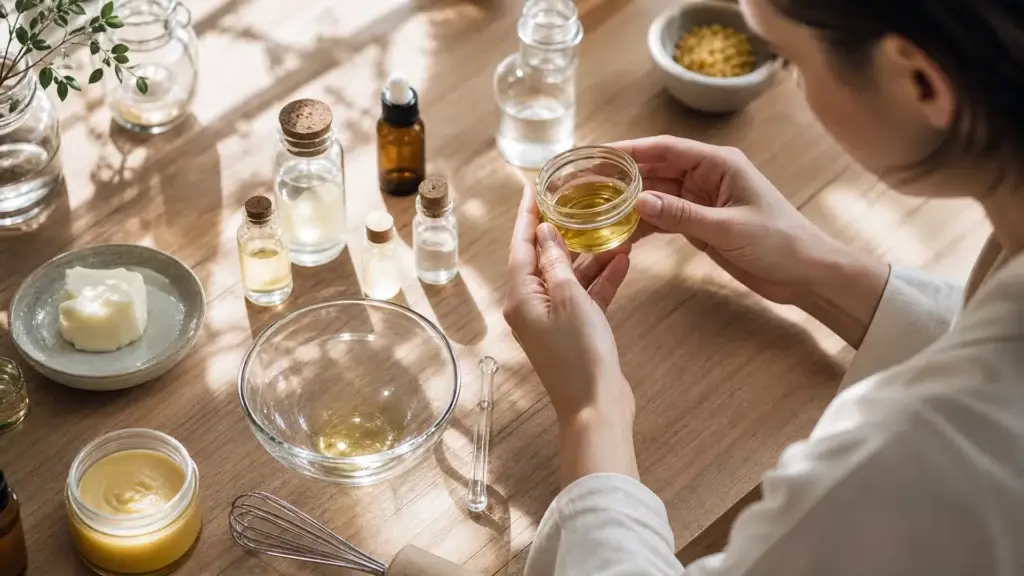
Beginners Guide to Skincare Formulation
If you’ve ever read the back of a moisturiser and wondered what half the ingredients actually do, you’re already thinking like a formulator. This beginners guide to skincare formulation is here to show you that making your own products is genuinely achievable, no lab coat or chemistry degree required. You need a few core concepts, some good ingredients, and the confidence to start simple.
What Is Skincare Formulation (and Why It’s More Accessible Than You Think)?
Skincare formulation is the deliberate combining of ingredients to create a functional product, something that performs a specific job on the skin, whether that’s moisturising, cleansing, or protecting. It’s less about inventing new molecules and more about understanding how existing ingredients work together.
Natural skincare formulation means creating cosmetic products using plant-derived ingredients, oils, butters, botanical extracts, and naturally sourced actives, rather than synthetic fillers and petrochemical derivatives.
People come to it for different reasons. Some want to know exactly what goes on their skin and their family’s skin. Others want to cut out synthetic fragrances, parabens, or silicones. Many find it genuinely cost-effective once they’re buying ingredients in bulk. And plenty simply love making something that works, by hand, from scratch.
Most beginner-friendly products rely on a handful of well-understood ingredient categories. Once you grasp those, you can follow a formula the way you’d follow a recipe. You don’t need to understand every reaction happening at a molecular level. You need to know what goes in your oil phase, what goes in your water phase, and when you need an emulsifier or a preservative. That’s a solid starting point.
The good news: you don’t need a chemistry degree. You need curiosity, a few core ingredients, and a willingness to take notes.
The Building Blocks: Understanding Your Ingredient Categories
Every skincare formula is built from a small set of ingredient families. Getting comfortable with these categories makes reading, and writing, formulas much easier.
Oils, Butters, and Waxes (Your Oil Phase)
Oils, butters, and waxes form the oil phase of any formula and are the heart of most beginner formulas.
Carrier oils (like jojoba, rosehip, or sweet almond) deliver skin-conditioning benefits, carry oil-soluble actives, and form the base of facial oils and body oils. Read more about how jojoba oil performs in a formula to understand why it’s a beginner staple.
Butters, shea, mango, cocoa, are solid at room temperature and add richness and body to balms and whipped products.
Waxes like beeswax (or candelilla wax for vegan formulas) add structure and hold. They’re what turn a liquid oil into a solid balm or lotion bar.
For your first formulas, oils and butters are your best friends. They’re forgiving, straightforward to work with, and don’t require any extra chemistry to make them safe. Browse carrier oils available at DIY Naturally to see what’s in stock and start building your ingredient kit.
Water, Hydrosols, and Aloe (Your Water Phase)
The water phase is the water-soluble portion of your formula. This can be distilled water, a floral hydrosol (like rose water or lavender water), or aloe vera juice. These ingredients carry water-soluble actives such as niacinamide or panthenol, and they contribute to the lightweight, hydrating feel of lotions and serums.
Water-containing formulas are more complex because they introduce both emulsification and preservation requirements. Most beginners skip the water phase entirely at first, and that’s completely sensible.
Emulsifiers, Actives, and Preservatives
Emulsifiers are the ingredients that let oil and water mix stably. Without one, your lotion will separate into two layers within hours.
Actives are your targeted ingredients, things like Hyaluronic Acid, niacinamide, plant extracts or antioxidants that deliver a specific skin benefit. A good starting active for beginners is Vitamin E, which also functions as an antioxidant that helps extend the shelf life of oils. See how to use Vitamin E oil in DIY skincare for a practical introduction.
Preservatives are non-negotiable in any formula that contains water. Water creates an environment where bacteria and mould can grow, even in a product that looks and smells fine. A broad-spectrum preservative keeps your product safe for its intended shelf life. More on that in the safety section below, and you can go deeper into choosing a natural preservative for your homemade cosmetics when you’re ready.
These three categories come into play as your formulas grow in complexity. DIY Naturally stocks all of them, from beginner-friendly emulsifiers through to a full range of cosmetic actives and natural preservatives, so you can source everything locally in South Africa.
A Beginner’s Guide to Skincare Formulation:
The Core Rules
Two rules will save you from the most common beginner mistakes. Get these down before you start your first batch.
Water + Oil = You Need an Emulsifier
Oil and water don’t mix on their own, they separate. An emulsifier is a molecule with one water-loving end and one oil-loving end; it sits between the two phases and holds everything together in a stable cream or lotion.
Emulsions come in two main types: oil-in-water (tiny oil droplets suspended in water, think lightweight lotions) and water-in-oil (water droplets sitting in an oil continuous phase, think richer, more occlusive creams). The emulsifier you choose determines which kind of emulsion you get.
The practical takeaway: if your formula has no water in it, you don’t need an emulsifier. Anhydrous (water-free) products like balms, body butters, and facial oils sidestep this entire complexity, which is exactly why they’re the best place to begin.
Anything with Water Needs a Preservative
This is non-negotiable. Water in a formula creates the conditions for bacteria, mould, and yeast to grow, even if you’re using clean equipment and working in a tidy kitchen. A properly chosen and correctly dosed preservative keeps your product safe for the duration of its use.
This applies to anything that contains water directly, and also to products that will come into contact with water during use (like a body scrub used in the shower). When you’re ready to add a water phase to your formulas, read up on choosing natural preservatives for homemade cosmetics before you start, it’s one of the most important steps you’ll take.
The 5-Step Process
This is the part that takes formulation from theory to practice. Follow these five steps for every product you make.
Step 1, Choose a Product Type and Target Skin Concern
Start by deciding what you’re making and who it’s for. A face oil for dry skin has different ingredient requirements than a body butter for sensitive skin. Defining your goal upfront keeps your formula focused and avoids the trap of throwing in every interesting ingredient you own.
Step 2, Build Your Formula on Paper First
Write out your ingredients as percentages, all ingredients in a formula must add up to 100%. This is how professional formulators work, and it makes scaling your batch up or down completely straightforward. Working in weight percentages rather than volume measurements ensures batch-to-batch consistency. A simple formulation notebook (physical or digital) is your best tool here.
Step 3, Weigh, Melt, and Combine Correctly
A digital scale is essential, never use spoons or cups for formulation. Weigh each ingredient precisely, then follow the correct addition order for your formula type (for emulsions, that means heating your oil and water phases separately before combining). Different ingredient types are added at different temperatures, so a thermometer matters too.
Step 4, Test, Adjust, and Record Everything
Once made, let your product cool completely before assessing texture, scent, and skin feel. Make small adjustments one variable at a time, changing multiple things at once makes it impossible to know what worked. Write down every change in your formulation notebook, including the date, batch size, and any observations.
Step 5, Package and Store Your Creation
Match your packaging to your product: wide-neck jars suit thick balms and body butters; pump bottles work well for lotions and serums; roller bottles are ideal for face and body oils. Store finished products away from direct sunlight and heat. Anhydrous products typically last 6–12 months; water-containing products depend on the preservative used and should always be labelled with a use-by date.
Your First Three Formulations: Start Simple, Build Confidence
The best way to learn formulation is to make something. These three products are ordered from simplest to most complex, work through them in sequence and you’ll build real skills with each batch.
1. A Body Oil or Facial Oil Blend
A body or facial oil is pure oil phase, no water, no emulsifier, no preservative needed. You’re blending carrier oils (and optionally a few drops of essential oil or a cosmetic active) in a bottle. It’s the ideal first formula because the only skill required is accurate weighing. Jojoba is one of the best starting points: it’s technically a liquid wax, so it has a much longer shelf life than most carrier oils and suits most skin types well. Read our in-depth jojoba oil formulation guide for everything you need to know before you blend.
2. A Whipped Body Butter
A whipped body butter is still anhydrous, no water, but adds butters and sometimes a small amount of wax or a soft oil to the blend, then whips the cooled mixture to a fluffy texture. It’s slightly more involved than a straight oil blend because you need to melt, cool, and whip correctly, but there’s no emulsification chemistry to worry about. It’s also enormously satisfying to make.
3. A Simple Emulsified Lotion
Once you’re comfortable with anhydrous products, a basic lotion is the natural next step. You’ll combine your oil phase and water phase separately, heat both to a similar temperature, then combine them with an emulsifier while mixing continuously. It takes practice, but the principles are straightforward. Follow the step-by-step guide to making a natural face cream when you’re ready, it walks you through the process in detail.
Tools, Safety, and Good Practice in Your Home Lab
You don’t need a fully equipped laboratory to formulate safely at home. A few key tools make all the difference.
A digital scale is the single most important piece of equipment you’ll buy. Cosmetic chemists universally recommend weighing ingredients in grams rather than measuring by volume, it’s the only way to get repeatable, accurate batches. A scale accurate to 0.1 g is ideal for small batches.
Heat-safe mixing vessels, stainless steel, glass, or high-density plastic, let you melt and combine your oil phase safely. Keep a dedicated set for formulation only; cross-contamination from food residues is a real concern.
A clean, sanitised workspace matters more than most beginners expect. Wipe down surfaces with isopropyl alcohol before you start, and sanitise your tools the same way. Label every batch with the date, the formula reference, and the batch number.
Keep a formulation journal. Record your formula percentages, batch size, what you changed from the previous version, and how the product performed. It turns each batch into a learning experience rather than a one-off experiment. And always patch-test a finished product on a small area of skin before using it more broadly.
Safety, Hygiene, and Common Beginner Mistakes to Avoid
Safe formulation isn’t complicated, but it does require a few non-negotiables.
Sterilise your equipment before every batch. Wash with hot soapy water, rinse well, then wipe down with isopropyl alcohol (70% is effective) and allow to air dry. This removes surface contamination that could compromise your product.
Always use a preservative in water-containing formulas. This is the most common mistake beginners make, assuming that natural ingredients or refrigeration are enough. They aren’t. A water phase creates the conditions bacteria and mould need to grow, regardless of how “clean” your other ingredients are.
Work in weight, not volume. Measuring by the teaspoon introduces inconsistency that makes it impossible to reproduce a formula that worked. A digital scale removes that variable entirely.
Respect usage rates for actives and essential oils. Essential oils are potent, for leave-on skincare products, the safe range is typically 1–3% of the total formula. Exceeding recommended usage rates is one of the most common causes of skin sensitivity reactions in homemade cosmetics. Always check guidelines from IFRA (the International Fragrance Association) or your ingredient supplier before formulating.
Patch-test every new product before applying it to your face. Apply a small amount to the inside of your wrist or elbow, leave for 24 hours, and check for any reaction. This is good practice even with ingredients you’ve used before, because formula combinations can behave differently.
Building Your DIY Skincare Toolkit and Ingredient Starter Kit
You don’t need much to get started. Here’s what actually matters.
Essential equipment:
- Digital scale (accurate to 0.1g)
- Digital thermometer
- Glass or stainless steel jugs (at least two, for oil and water phases)
- Stick blender or hand mixer
- Isopropyl alcohol (70%) for sanitising
- Pipettes and spatulas
- Formulation notebook
Core starter ingredients:
- One or two carrier oils (jojoba, sweet almond, rosehip)
- A soft butter (shea or mango)
- Beeswax or candelilla wax
- A broad-spectrum preservative (for when you move to emulsions)
- Vitamin E (tocopherol) as an antioxidant
- Distilled water
- One emulsifier (such as Olive M1000 or Emulsifying Wax BP)
Storage conditions for all ingredients are broadly the same: cool, dark, and dry. Butters and waxes should be stored away from heat sources. Actives and preservatives often have specific storage requirements listed on their technical data sheets, follow those.
DIY Naturally stocks all of these, carrier oils, butters, emulsifiers, preservatives, cosmetic actives, and packaging, in one South African store, so you’re not piecing together an order from multiple international suppliers. Browse our range of carrier oils to choose your base and get started.
Formulation is a skill that builds on itself. Start with a lip balm, nail it, then make a body butter. Once that feels easy, try your first emulsion. Each project teaches you something that makes the next one better, and our full beginner’s guide to skincare formulation is always here to take you deeper. Every experienced formulator started exactly where you are now.
Disclaimer: All recipes and formulas are shared in good faith. DIY Naturally is not liable for any adverse reactions. Always perform a patch test before use, and substitute ingredients if you have known allergies. Use at your own discretion.