D Panthenol Gel Vs DL Panthenol Powder: Key Differences
Panthenol is one of those ingredients that earns its place in almost every formula you’ll make. Whether you’re building a face serum, a shampoo, or a leave-in conditioning spray, it delivers real, measurable results, hydration, softness, and a strengthened skin barrier. But once you start shopping for it, you’ll quickly notice two distinct options on the shelf: D Panthenol Gel and DL Panthenol Powder. Understanding D Panthenol Gel vs DL Panthenol Powder, what are the differences and how to use in personal care is the key to choosing the right form for your project. This guide breaks it all down in plain language so you can formulate with confidence.
If you’re newer to working with actives, a solid beginner’s guide to skincare formulation is a great place to see how ingredients like panthenol fit into a complete formula before diving into the detail here.
What Is Panthenol and Why Do DIY Formulators Love It?
Panthenol is the alcohol form of pantothenic acid, provitamin B5. The skin and hair convert it into pantothenic acid, where it supports cellular metabolism and tissue repair. Cosmetically, this translates to three headline benefits: humectancy (it draws moisture into the skin), conditioning (it softens and smooths hair and skin), and barrier support (it helps skin maintain its protective function).
It’s one of the most frequently listed actives in leave-on moisturisers, conditioners, and healing balms globally. Decades of use across every skin type, including sensitive and compromised skin, back up its safety and effectiveness. For DIY makers, it’s also beginner-friendly: it works at low concentrations, plays well with other actives, and doesn’t require a chemistry degree to handle correctly.
D Panthenol Gel vs DL Panthenol Powder: Key Differences Explained
Chirality, Purity, and What the Letters Actually Mean
The letters D and DL refer to chirality, the “handedness” of a molecule. Panthenol can exist in two mirror-image forms: the D (dextrorotatory) form and the L (laevorotatory) form. These look identical on paper but behave differently in biological systems.
Cosmetic chemists widely regard the D enantiomer as the biologically active form. Skin and hair follicle enzymes preferentially convert D-panthenol into pantothenic acid, which drives the real skin and hair benefits. The L form isn’t harmful, but it doesn’t convert in the same way and contributes little to efficacy.
D Panthenol Gel contains only the D enantiomer, it’s the purer, more targeted form. DL Panthenol Powder is a racemic mixture: an equal split of D and L forms. In practical terms, DL powder is roughly half as bioactive by weight as D panthenol gel, because only the D portion is doing the active work.
Physical Form, Solubility, and Ease of Use
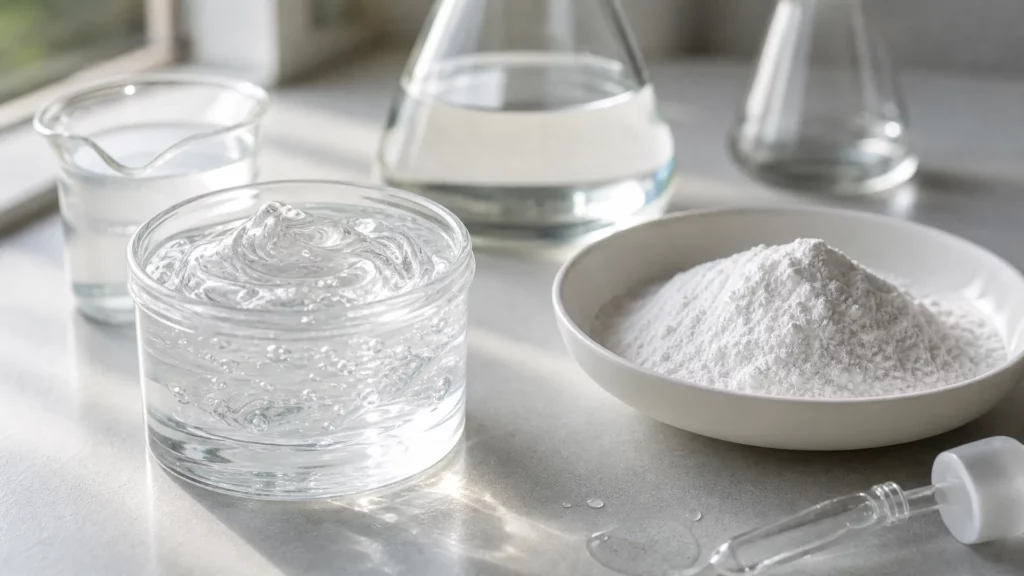
D Panthenol Gel is a thick, viscous liquid. It’s already in a ready-to-use format that dissolves easily into the water phase of your formula without any extra steps. It typically contains around 75% active panthenol, with water making up the balance.
DL Panthenol Powder is a dry, white, crystalline powder. It’s more concentrated (close to 100% panthenol) and is also water-soluble, but you’ll need to pre-dissolve it in a small amount of warm water before incorporating it into your formula. It’s hygroscopic, meaning it absorbs moisture from the air, so handling and storage require a little more care.
Both forms are water-soluble and are not suitable for straight anhydrous (oil-only) formulas without a water phase or polar solvent present.
Performance in Skin and Hair Care: Which Form Does What?
Skin Benefits: Hydration, Barrier Repair, and Wound Healing
In skin care, panthenol works as a humectant by attracting water molecules and holding them in the upper layers of the skin. It also supports the skin’s barrier by stimulating fibroblast proliferation and accelerating wound re-epithelialisation, which is why you’ll find it in products marketed for dry, irritated, or compromised skin.
For targeted actives work, a barrier-repair serum, a post-procedure balm, or a sensitive-skin moisturiser, D Panthenol Gel is the preferred choice. You’re getting the full bioactive D form at a meaningful concentration, with no L-form dilution. At 3–5% in a face serum, it delivers a noticeable improvement in hydration and skin feel.
DL Panthenol Powder is a sound, cost-effective option for general-purpose skin products where you want broad moisturising and conditioning support rather than targeted therapeutic action. It pairs well with vitamin E in DIY skincare formulas for a well-rounded barrier-support stack.
Hair Benefits: Shine, Moisture Retention, and Scalp Care
In hair care, panthenol is a genuine workhorse. It penetrates the hair shaft, binding to the cortex and increasing hair’s moisture-holding capacity. The result is softer, shinier hair with reduced frizz and improved manageability. It also supports scalp health, making it a useful addition to dandruff or dry-scalp formulas.
For rinse-off products like shampoos, the short contact time with the scalp means the cost-efficiency argument favours DL Panthenol Powder, you get good conditioning performance without the premium price of the pure D form. A typical leave-in hair conditioning spray might include 2% DL Panthenol Powder dissolved in the water phase, providing meaningful moisture retention and frizz reduction at a lower raw-material cost than the equivalent weight of D Panthenol Gel.
For leave-in treatments, glossing serums, or scalp treatment products where contact time is longer and bioactivity matters more, D Panthenol Gel is worth the upgrade. It also works well alongside natural silicone alternatives for conditioning in formulas aimed at replacing conventional silicone-heavy conditioners.
How to Use D Panthenol Gel and DL Panthenol Powder in Your Formulas
Usage Rates and When to Add Each Form
Both forms are heat-sensitive, so always add them in the cool-down phase, when your formula has dropped below 40°C. Adding panthenol to a hot water phase risks degradation and reduced efficacy.
D Panthenol Gel: Use at 0.5–5% of your total formula weight. For a light everyday moisturiser, 1–2% is sufficient. For a barrier-repair serum or intensive treatment, push up to 3–5%.
DL Panthenol Powder: Use at 0.5–5% as well, but remember the powder is more concentrated (nearly 100% panthenol vs approximately 75% in the gel). Pre-dissolve the powder in a small amount of warm distilled water before adding to the cool-down phase. This prevents clumping and ensures even distribution. Because the DL form is half bioactive by weight, you may want to formulate at the higher end of the range to match the effective D-panthenol dose in your formula.
Both forms are compatible with a broad pH range (around 4–7) and are stable in most standard cosmetic formulations.
Compatible Product Types and Simple Starter Recipes
D Panthenol Gel suits:
- Face serums and essences (3–5%)
- Eye creams and barrier balms (1–3%)
- Leave-in hair treatments and scalp serums (2–4%)
- Baby and sensitive-skin products (1–2%)
DL Panthenol Powder suits:
- Shampoos and rinse-off conditioners (1–3%)
- Body lotions and everyday moisturisers (1–3%)
- Leave-in conditioning sprays (2%)
- Scalp tonics (1–2%)
A simple starter: add 2% DL Panthenol Powder (pre-dissolved) to the cool-down phase of your shampoo base, stir well, and adjust pH to 5–5.5 before bottling. For a face serum, try 3% D Panthenol Gel alongside betaine as a humectant active in your water phase for a simple but effective hydration formula.
Since both forms require a water phase, remember that preserving your water-containing formulas is non-negotiable, any formula with water needs an effective broad-spectrum preservative.
Choosing the Right Form for Your DIY Project
Here’s a quick decision guide:
Reach for D Panthenol Gel when:
- You’re making a small batch and want a ready-to-use, pre-dissolved active
- Your formula is water-based and you want maximum bioactivity
- You’re formulating for targeted skin repair, sensitive skin, or a leave-on hair treatment
- You want to minimise weighing and dissolving steps
Reach for DL Panthenol Powder when:
- You’re buying in larger quantities and cost-efficiency matters
- You’re making rinse-off products where short contact time reduces the need for pure D-form potency
- You need a shelf-stable ingredient that stores well long-term in a sealed container
- You’re formulating anhydrous products with a small water fraction, the powder is easier to pre-dissolve in a controlled amount
Both options are stocked at DIY Naturally as cosmetic actives, giving South African makers the choice to match their batch size, formula type, and budget. For a practical next step with the gel form, making a natural face cream at home is a great place to put it to use.
Tips for Storing and Handling Panthenol Safely
D Panthenol Gel: Store in a cool, dry place away from direct sunlight. Avoid prolonged heat exposure, which can degrade the active. Refrigeration isn’t required but extends shelf life in warmer climates. Keep the lid tightly closed between uses.
DL Panthenol Powder: Store in an airtight, moisture-proof container, this is the more hygroscopic of the two forms, and exposure to humid air will cause clumping and eventually degradation. Use a silica gel sachet in your storage container if you’re in a humid environment. Keep away from heat and direct light.
Both forms have a typical shelf life of around two years when stored correctly. Always label your containers with the purchase date and check for any changes in colour, smell, or texture before use.
Good storage habits protect your investment and your formulas. There’s no point using a degraded active and wondering why your product isn’t performing.
Whether you’re reaching for D Panthenol Gel for a precision barrier serum or DL Panthenol Powder for a cost-effective conditioning shampoo, both forms earn their place in a well-stocked DIY lab. Browse DIY Naturally’s cosmetic actives range to pick up whichever form (or both) suits your next project, and formulate knowing exactly what you’re working with.