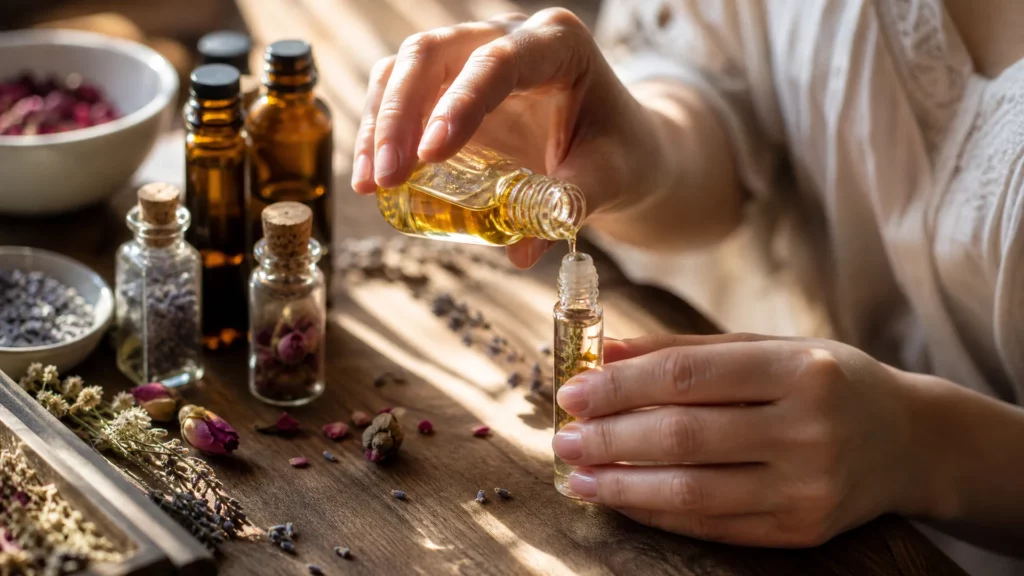
DIY Natural Perfume Rollers: Make Your Own Scent
Making your own DIY natural perfume rollers is one of the most satisfying beginner formulation projects you can take on. The process is straightforward, the ingredients are affordable, and the result is a personal scent you know inside out, because you made it yourself. Whether you want a signature fragrance for everyday wear or you’re exploring small-batch making, roller perfumes are the ideal starting point.
Why is it worth making DIY Natural Perfume Rollers
Commercial perfumes are expensive, and their ingredient lists rarely tell the full story. “Fragrance” on a label can legally represent dozens of undisclosed synthetic compounds. When you make your own, you choose every ingredient, carrier oil, essential oils, fragrance blends, all of it.
Cost is a real incentive too. A quality 10 ml roller perfume from a boutique brand can cost several hundred rands. A homemade version, using good-quality ingredients, costs a fraction of that, and you end up with the skills and supplies to make a dozen more.
Creative control is the other big draw. You can build a scent around what you actually love, adjust the strength to suit your skin, and tweak it over time. No compromise, no settling for “close enough.”
Choosing the Right Carrier Oil for Your Perfume Roller
The carrier oil is the base of your roller perfume. It dilutes the fragrance to a skin-safe concentration, affects how the scent develops on your skin, and determines how the product feels to apply. A heavy, greasy oil can muffle your fragrance and feel unpleasant on the wrists or neck.
Best Carrier Oils for a Lightweight, Non-Greasy Finish
These are the most practical options for perfume rollers:
- Jojoba oil, The top pick for most formulators. Jojoba is technically a liquid wax rather than a true oil, which gives it a remarkably long shelf life and a skin feel that closely mimics the skin’s own sebum. It absorbs without greasiness and won’t compete with your fragrance. Read more about why jojoba oil is a top choice for leave-on formulas.
- Fractionated coconut oil, Light, odourless, and very stable. It stays liquid at room temperature and has a long shelf life, making it a reliable alternative to jojoba.
- Sweet almond oil, Slightly richer than the above two, with a faint nutty scent. Absorbs well and suits drier skin types.
- Apricot kernel oil, Very light and virtually scentless. A good option if you want a smooth application without heaviness.
All four work well. Jojoba is the most forgiving for beginners because it’s so stable.
To extend shelf life further, add Vitamin E oil at around 0.5–1% of your total formula weight. It acts as a natural antioxidant, slowing oxidation in the carrier oil and keeping your finished roller smelling fresh for longer. For more detail on this, see how Vitamin E oil helps extend shelf life in DIY products.
How Carrier Oil Choice Affects Scent Throw and Skin Feel
Lighter oils (jojoba, fractionated coconut) let the fragrance sit closer to the surface of the skin, which gives a cleaner initial throw. Richer oils (sweet almond, apricot kernel) absorb a little more slowly and can give a slightly softer, more skin-warmed scent. Neither is wrong, it depends on the effect you want and your skin type.
If you’re new to this, understanding the difference between essential oils and carrier oils before you start will help you shop and formulate with more confidence.
Understanding Fragrance Ratios for a Natural Perfume Recipe
Getting your fragrance ratio right is what separates a perfume that lasts from one that fades in an hour. A bit of simple maths makes a big difference to your results.
Top, Middle, and Base Notes Explained
Professional perfumers have long worked with the top-middle-base note pyramid, originally formalised by 19th-century perfumer Septimus Piesse, to build fragrances that evolve on the skin over time. The same principle applies directly to DIY oil-based roller blends.
- Top notes are what you smell first: bright, volatile, and short-lived. Think citrus, bergamot, lemon, eucalyptus.
- Middle notes (or heart notes) form the core character of the scent. They emerge as the top notes fade, florals like rose and ylang ylang, or herbals like lavender.
- Base notes are the anchor: deep, slow to evaporate, and the longest-lasting. Sandalwood, cedarwood, vanilla, patchouli, and frankincense are classic examples.
A well-balanced roller perfume typically uses roughly 30% top notes, 50% middle notes, and 20% base notes, though this is a guide, not a rule. The guide to mixing perfume with essential oils goes deeper into this layering approach if you want to build your blending confidence.
Recommended Dilution Rates for Roller Bottles
Oil-based roller perfumes work on the same concentration principles as traditional alcohol-based perfumes, adapted for the carrier oil format:
| Strength | Fragrance % | Drops in 10 ml roller |
|---|---|---|
| Eau de Cologne (light) | 1–3% | 6–9 drops |
| Eau de Toilette | 5–8% | 15–24 drops |
| Eau de Parfum | 10–15% | 30–45 drops |
For most beginners, eau de toilette strength (5–8%) is a practical starting point, noticeable on the skin without being overwhelming, and economical with your essential or fragrance oils. A standard 10 ml bottle at eau de parfum strength requires just 30–45 drops total, so even a small quantity of oils goes a long way.
Step-by-Step: Three Natural Perfume Roller Recipes to Try
Each recipe is designed for a 10 ml roller bottle. Build your blend in a small glass beaker, then funnel or pipette it into the bottle. Always make a note of what you used so you can recreate or adjust it.
Floral & Fresh: Rose and Bergamot Roller
A light, feminine blend with a clean citrus lift and a soft floral heart. Uses pure essential oils throughout.
Ingredients:
- Jojoba oil, to fill (approx. 9.5 ml)
- Rose essential oil, 10 drops (base/middle)
- Bergamot essential oil, 12 drops (top)
- Ylang ylang essential oil, 5 drops (middle)
- Vitamin E oil, 2–3 drops
Method: Combine all oils in a small dropper bottle or beaker. Mix gently. Pour into your 10 ml roller bottle and seal. Rest for 24 hours before wearing.
Warm & Woody: Sandalwood and Vanilla Fragrance Oil Blend
A richer, longer-lasting scent that works well in cooler months. This recipe uses fragrance oils, which deliver reliable, consistent results and are a perfectly valid natural fragrance alternative to pure essential oils.
Ingredients:
- Fractionated coconut oil, to fill
- Sandalwood fragrance oil, 15 drops (base)
- Vanilla fragrance oil, 10 drops (base/middle)
- Frankincense essential oil, 8 drops (base/middle)
- Vitamin E oil, 2–3 drops
Method: Combine in a beaker, stir gently, fill the roller bottle, and cap. This blend benefits from a full 48-hour rest before evaluation, the base notes need time to round out.
Browse fragrance oils and perfume supplies to find the sandalwood and vanilla options used here.
Citrus & Green: Lemongrass and Cedarwood Essential Oil Perfume Roller
Bright and earthy, with a grounding cedarwood base that stops the lemongrass from feeling too sharp. A great everyday unisex option.
Ingredients:
- Sweet almond oil, to fill
- Lemongrass essential oil, 14 drops (top)
- Cedarwood essential oil, 12 drops (base)
- Peppermint essential oil, 4 drops (top)
- Vitamin E oil, 2–3 drops
Method: Combine, fill, cap, and rest for 24 hours. The cedarwood will mellow and integrate with the lemongrass on resting.
For more blend ideas across different uses, the essential oil roller bottle blend recipes collection is worth exploring.
Choosing and Filling Your Perfume Roller Bottle
The roller bottle you choose affects both the user experience and how well the formula stays fresh.
Material: Stainless steel roller balls give the smoothest application and don’t absorb scent or degrade over time. Plastic roller balls are fine for personal use but can retain old scents if you want to refill with a different blend. For a perfume roller you plan to use regularly, stainless steel is worth it.
Size: 10 ml is the most practical size for beginners. It’s large enough to last several weeks with daily use, small enough that if you want to try a different scent you haven’t committed to a huge batch. The roller bottles available in the DIY Naturally shop come in multiple sizes to suit both personal makers and those producing small batches for sale.
Filling: Remove the roller ball insert (it usually pops out with a flat tool or fingernail), fill the bottle using a small pipette or funnel to within 1–2 mm of the top, then press the roller ball insert firmly back in. Wipe the outside clean and cap it. Fill slowly to avoid air bubbles or spillage.
Labelling: For personal use, a simple label with the blend name, date, and ingredients is good practice. If you plan to sell, South African cosmetics regulations require full ingredient labelling in INCI format, something to research before scaling up.
Essential Oil Blending Tips to Refine Your Scent
A few habits that separate good results from great ones:
Test on a scent strip first. Before filling a whole bottle, drop your blend onto a paper strip and smell it at intervals over 10–15 minutes. You’ll get a quick sense of how the notes develop without committing all your ingredients.
Let your blend rest. Once filled, leave your roller perfume for 24–48 hours before making a final judgement on the scent. Oils need time to marry, a blend that smells disjointed fresh will often round out beautifully after resting.
Keep a blend journal. Write down every recipe, drop counts, oil brands, dates, and your notes on the result. This is how you build a personal repertoire and recreate your best work.
Patch test before wide application. Apply a small amount to the inside of your elbow and wait 24 hours before using freely, especially with new essential oils or high-concentration blends. Some essential oils (citrus ones like bergamot in particular) can increase photosensitivity, so avoid direct sun exposure on freshly applied skin.
Start simple. A two- or three-ingredient blend is far easier to evaluate and adjust than a complex eight-ingredient formula. Nail the simple ones first, then layer in complexity.
If you’re brand new to making your own cosmetic products, the beginner’s guide to formulating your own cosmetics is a solid foundation before you dive into perfume work.
DIY Naturally stocks roller bottles, carrier oils, essential oils, and fragrance oils all in one place, so you can source everything for your first perfume roller recipe without waiting on international shipping. That’s a real advantage when you’re keen to get started and want to experiment without a big upfront spend.
Disclaimer: All recipes and formulas are shared in good faith. DIY Naturally is not liable for any adverse reactions. Always perform a patch test before use, and substitute ingredients if you have known allergies. Use at your own discretion.