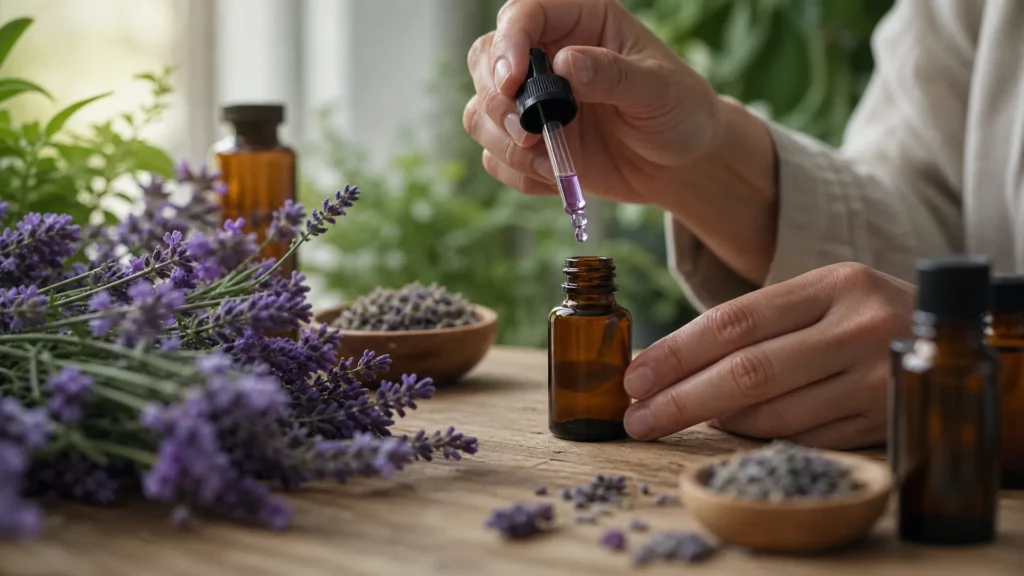
Lavender Essential Oil Skin Benefits: DIY Recipes & Safety Guide
Lavender is one of those ingredients that almost every maker reaches for first, and for good reason. The lavender essential oil skin benefits are well-documented in both traditional use and modern cosmetic science, making it a genuinely useful addition to a formulation rather than just a pretty scent. But there’s a difference between dabbing a drop on a spot and formulating a proper face oil at a safe, effective dilution. This guide covers both: what lavender actually does for skin, how to use it safely, and how to make your first DIY lavender serum or face oil at home.
If you’re new to working with essential oils, the beginner’s guide to skincare formulation is a good starting point before you dive into the recipes below.
What are the Lavender Essential oil Skin Benefits
Lavender essential oil (Lavandula angustifolia) is not a cure-all, but it earns its place in skincare formulations for several concrete reasons. Its two primary active compounds, linalool and linalyl acetate, which together typically make up 50–90% of the oil’s composition, are associated with antimicrobial activity, reduced inflammation, and a calming effect on irritated skin. That combination is rare in a single ingredient.
Formulators reach for lavender because it sits across multiple skin concerns: broad-spectrum enough to be useful in acne blends, soothing enough for reactive skin, and gentle enough (at the right dilution) for most skin types.
Lavender Oil for Acne and Blemish-Prone Skin
Lavender oil for acne works through two mechanisms. First, it has demonstrated antimicrobial activity against several bacteria, including strains associated with acne. Second, its anti-inflammatory compounds reduce the redness and swelling around blemishes rather than just targeting the bacteria causing them.
It isn’t as aggressive as tea tree oil, which is actually a benefit. Lavender won’t strip or over-dry skin, making it more suitable for daily-use formulas or for skin that reacts badly to stronger actives. The practical result: lavender works well as a supporting ingredient in an acne blend, not necessarily as the star on its own.
Calming, Soothing, and Anti-Inflammatory Properties
Beyond acne, lavender’s main strength in skincare is calming reactive, sensitised, or post-treatment skin. Linalool specifically has been studied for its ability to inhibit inflammatory responses at a cellular level, that’s why lavender appears in formulations for redness, eczema-prone skin, and post-shaving irritation.
It also sits in that useful middle ground of not being photosensitising (unlike many citrus oils), which means it’s safe to use in leave-on daytime products at normal dilution rates.
Lavender Essential Oil vs Hydrosol: Which One Should You Use?
Understanding the lavender essential oil vs hydrosol distinction saves a lot of formulation headaches. They’re both derived from lavender, but they behave very differently in a formula.
Lavender essential oil is the concentrated, oil-soluble aromatic compound extracted by steam distillation. It doesn’t mix into water without an emulsifier or solubiliser, and it requires careful dilution. A small amount goes a long way.
Lavender hydrosol (also called floral water or distillate) is the water-based by-product of that same distillation. It contains trace aromatic compounds and carries a much gentler lavender character. Because it’s water-soluble, it can replace plain water in your formula, in toners, mists, emulsions, and serums with a water phase, at much higher percentages than you’d ever use the essential oil.
For sensitive or reactive skin, hydrosol is often the smarter choice. It delivers some of the calming properties of lavender without the sensitisation risk that comes with concentrated essential oils at higher percentages. If you’re making a facial toner or a water-phase serum, reach for the hydrosol. If you’re making an anhydrous (oil-only) product like a face oil or balm, the essential oil is what you want.
Lavender Oil Dilution: Getting the Safe Percentage Right
This is where beginners most often go wrong, and it’s the most important section in this article. Essential oils are active ingredients with a dose. They are not fragrance. Treating them that way, especially in products applied daily to the face, is how sensitisation happens.
Formulation educators and organisations like IFRA consistently recommend keeping facial dilutions at or below 1–2% for leave-on products. For body products, you have a little more room, up to 3% is generally considered safe for most adults.
A 1% dilution in a 30 ml bottle equals approximately 6 drops of essential oil. That number surprises most beginners. It really is that small, and it’s genuinely effective at that level.
Recommended Dilution Rates by Product Type
| Product type | Recommended lavender EO % |
|---|---|
| Face oil (leave-on) | 1% |
| Face serum (leave-on) | 0.5–1% |
| Body oil (leave-on) | 2–3% |
| Rinse-off body products | Up to 3% |
| Products for sensitive skin | 0.5% or less |
Stick to the lower end if you’re making a product you’ll use every day. Daily cumulative exposure is the main driver of sensitisation, not a single high dose.
Understanding the difference between essential oils and carrier oils helps here too, carrier oils are not diluted the same way and can make up the bulk of your formula.
Choosing the Right Carrier Oil for a Lavender Face Oil
Carrier oil selection is a formulation decision, not just a safety step. The carrier determines the skin feel, absorption rate, and suitability for different skin types, so it’s worth thinking about beyond just “what can I dilute lavender into?”
For acne-prone or oily skin, jojoba oil for facial formulations is the classic pairing. Its structure closely mimics the skin’s own sebum, it’s non-comedogenic, and it absorbs cleanly without leaving a heavy residue. For drier or more mature skin, consider rosehip or marula as your primary carrier, with jojoba as a secondary.
DIY Lavender Face Oil Recipe (and a Simple Serum Blend)
Both recipes below are beginner-friendly and built around percentage-based formulation. Scale them to any batch size you like, the percentages stay the same.
Basic Lavender Face Oil Recipe
This is a simple, three-carrier face oil with lavender at 1%. It suits normal to oily or combination skin.
Makes: 30 ml
| Ingredient | % | Amount (30 ml batch) |
|---|---|---|
| Jojoba oil | 60% | 18 ml |
| Rosehip seed oil | 30% | 9 ml |
| Vitamin E oil (tocopherol) | 9% | 2.7 ml |
| Lavender essential oil | 1% | ~6 drops |
Method: Measure your carrier oils into a clean glass dropper bottle. Add the lavender essential oil drops last. Cap and roll gently to blend. Label with the date, expect a 6–12 month shelf life, driven by the rosehip oil.
Shop the ingredients: You’ll find pure lavender essential oil, jojoba, rosehip, and glass dropper bottles all in one place at DIY Naturally.
Lavender Serum Recipe with Actives
This oil-serum sits between a serum and a face oil, richer than a water-based serum but lighter than a pure oil. It’s still anhydrous, so no preservative is needed. If you add any water phase or aloe, see the guidance on adding a preservative to your water-containing formulas.
Makes: 30 ml
| Ingredient | % | Amount (30 ml batch) |
|---|---|---|
| Jojoba oil | 50% | 15 ml |
| Squalane | 30% | 9 ml |
| Marula oil | 15% | 4.5 ml |
| Vitamin E oil | 4% | 1.2 ml |
| Lavender essential oil | 1% | ~6 drops |
Using vitamin E as a supporting active in your serum serves two purposes: it contributes antioxidant activity and extends the shelf life of your more vulnerable oils like marula.
Shop the ingredients: Pick up the full ingredient list for both recipes from DIY Naturally’s essential oils and carrier oils range, glass dropper bottles and roller bottles are stocked too.
How to Source Pure Lavender Oil for Skin: What to Look For
Quality matters more with lavender than with almost any other essential oil, because lavender is one of the most frequently adulterated and mislabelled oils on the market. Here’s what to check before you buy.
Botanical name: Look for Lavandula angustifolia (also sold as L. officinalis). This is true lavender. Lavandin (Lavandula x intermedia) is a hybrid with a sharper, camphor-heavy scent profile, it’s cheaper and far more commonly used to adulterate or substitute for true lavender. It’s not a bad ingredient, but it’s not what you want for a calming face product.
Country of origin: Bulgaria, France (particularly Provence), and some UK-grown cultivars are considered premium sources. The altitude at which lavender is grown directly affects its linalool and linalyl acetate content, which is why mountain-grown Bulgarian lavender is so widely cited in formulation communities.
Avoid fragrance oils: Synthetic lavender fragrance oils are designed to smell like lavender, not to deliver skin benefits. They won’t contain linalool or linalyl acetate at meaningful levels. Always check that you’re buying a true essential oil, not a blended or synthetic fragrance.
For South African makers, sourcing pure lavender essential oil locally avoids the import cost and delay, and DIY Naturally stocks the quality lavender and companion ingredients you need for any of the recipes in this article.
Essential Oil Blending Tips: Making Lavender Work Harder in Your Formulas
Lavender is one of the most versatile blending oils you’ll work with. It sits as a middle note with some top-note character, it opens quickly but doesn’t disappear fast, which makes it a natural bridge between heavier base notes and lighter top notes in a blend. For more on how lavender sits within a fragrance blend, the perfume blending guide goes into the mechanics in detail.
In skincare formulations, the most useful pairings are:
- Tea tree, adds targeted antimicrobial punch for acne blends. Keep tea tree at 0.5–1% alongside lavender at 1% in a face oil. Together they cover more bacterial strains than either does alone.
- Frankincense, a classic pairing for mature or ageing skin. Frankincense brings boswellic acid activity and a grounding, resinous depth. Blend at 0.5% frankincense with 1% lavender in a richer oil base.
- Roman chamomile, for very sensitive or reactive skin, chamomile and lavender together is a gentle, low-irritation combination that delivers real calming results. Both at 0.5% in a face oil keeps total essential oil load at 1%, which is the right ceiling for reactive skin.
If you want to move beyond face oils into essential oil roller bottle blends to try, roller bottle formats are one of the easiest ways to build your confidence with blending, the small batch size means less waste when you’re experimenting.
The core rule with all blending: add your essential oils to your formula last, after you’ve combined your carriers. Keep a record of every formula you make with batch size, percentages, and date. It’s the only way to reliably repeat a result you love.
Disclaimer: All recipes and formulas are shared in good faith. DIY Naturally is not liable for any adverse reactions. Always perform a patch test before use, and substitute ingredients if you have known allergies. Use at your own discretion.