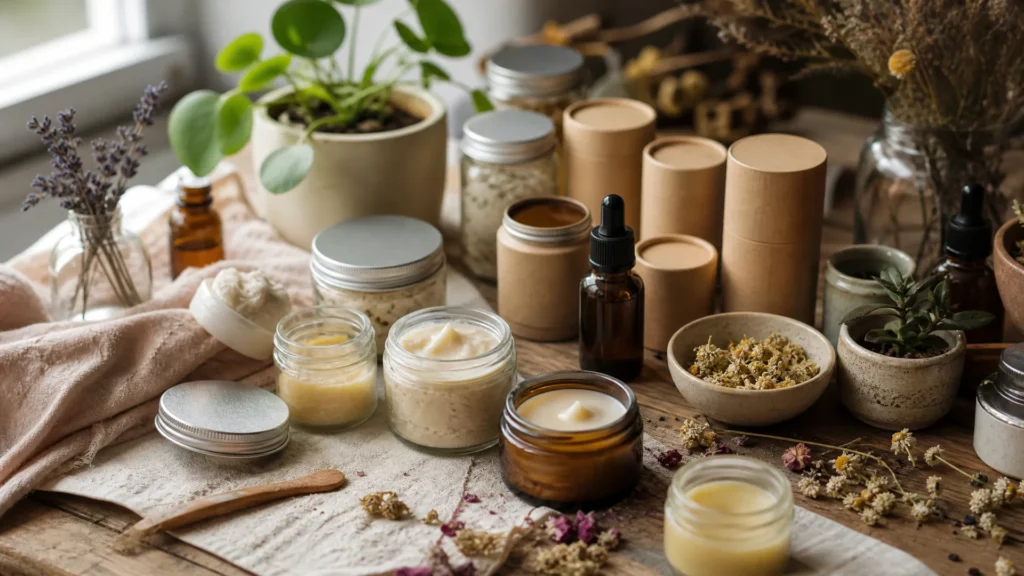
Sustainable Packaging for Beauty Products
If you make your own beauty products, you already make choices that most big brands can’t, you pick every ingredient, every process, and every container. In 2026, sustainable packaging for beauty products is no longer a niche concern; it’s a genuine expectation from conscious consumers and a real opportunity for DIY makers to stand out. Whether you’re selling at a market, gifting to friends, or building a small online brand, the vessel your product goes into tells a story. The good news: you don’t need a procurement department to get it right.
Why Sustainable Packaging Matters for DIY Beauty Makers
Plastic-free beauty packaging has moved from trend to baseline expectation. Customers read labels, ask questions, and notice when a handmade product arrives in single-use plastic that ends up in landfill. For a small-batch maker, that scrutiny is actually an advantage, you can switch containers between batches, trial new formats, and respond to customer feedback without a 12-month supply-chain renegotiation.
There’s an ethical dimension too. Choosing packaging deliberately, rather than defaulting to whatever’s cheapest, is part of what makes handmade beauty meaningful. It signals care, and care is exactly what your customers are paying for.
If you’re still getting comfortable with formulation itself, a beginner’s guide to skincare formulation is a good place to start before you finalise your packaging decisions, because the formula always drives the container choice.
Glass vs Plastic Packaging: Honest Trade-Offs for Home Formulators
The glass vs plastic packaging debate has no single right answer. Both materials have genuine strengths, and the best choice depends on your product, your customer, and your budget.
Where Glass Wins (and Where It Doesn’t)
Glass is chemically inert. It won’t react with your formula, leach anything into it, or degrade over time, which matters especially for oil-based serums and facial oils. Glass dropper and pump bottles are widely used by indie serum and facial-oil brands for exactly this reason: the packaging doesn’t interfere with the product, and it looks credible on a bathroom shelf.
Glass is also infinitely recyclable and widely accepted in South African kerbside recycling. Customers can see the product through clear glass, which builds trust. And there’s a tactile premium to glass that supports a higher retail price point.
The downsides are real. Glass is heavy, it adds to postage costs and breakage risk during shipping. For rinse-off products like shampoos or body washes that live in a wet shower, heavier glass bottles are less practical. And upfront, glass containers cost more per unit than equivalent plastic.
Best fit for glass: face serums, facial oils, toners, perfume blends, face creams, and eye serums. If you’re making a natural face cream at home, a glass pump bottle or wide-mouth glass jar is the natural packaging partner.
When Plastic Is Still a Pragmatic Choice
PET and HDPE plastics are lighter, shatterproof, and significantly cheaper per unit. For rinse-off products, shampoos, conditioners, body washes, shower gels, plastic is still the pragmatic standard. Both PET and HDPE are accepted by most South African recycling schemes, and HDPE in particular has a relatively strong secondary market locally.
The goal isn’t to avoid plastic entirely at all costs; it’s to use plastic deliberately where it genuinely makes sense, rather than by default everywhere.
Metal Tins for Skincare: Why Aluminium and Tin Are Worth Considering
Metal tins sit in a sweet spot that many DIY makers overlook. They’re durable, they feel premium in the hand, and aluminium is one of the most recycled materials on the planet, it can be recycled indefinitely without any loss of quality. Most plastics downcycle after one or two recycling cycles and eventually become non-recyclable waste. That makes aluminium a genuinely circular choice, not just a greener-looking one.
For brand differentiation, metal tins are hard to beat at their price point. A matte black or silver aluminium tin looks considered and giftable in a way that a plain plastic pot rarely does, without necessarily costing more.
Best fit for metal tins: lip balms, solid body butters, face balms, healing salves, solid moisturisers, and pressed or loose eye shadows. Lip balms and solid body butters are a natural starting point, the formula contains no free water, so there’s no risk of corrosion or liner interaction, and the tin adds a premium, giftable feel that supports a higher retail price. If you’re making your own natural lip balm, a small aluminium tin is one of the most cost-effective sustainable vessels you can choose.
One practical caution: acidic or water-based formulas can react with bare metal over time. If your product contains significant water content or acidic ingredients (like vitamin C or AHAs), choose a lined tin, the interior lining creates a barrier between formula and metal. Always check with your supplier whether a tin is lined before filling it with a water-based product.
Refillable Beauty Product Containers: Building Loyalty and Reducing Waste
Refillable packaging flips the standard retail model. Instead of selling a new container every time, you sell a premium vessel once, a heavy glass pump bottle, an aluminium spritzer, or a wide-mouth jar, and then offer subsequent refills in a lightweight, lower-cost format. The customer’s cost per use drops over time, your material use falls, and repeat purchases become the norm rather than the exception.
This model works particularly well for face creams, body oils, facial mists, and essential oil roller bottle blends, where the vessel itself has a long useful life and the formula is what gets replaced.
Reusable cosmetic containers, glass pump bottles, aluminium spritzers, roller bottles, wide-mouth glass jars, are the backbone of this approach. They’re also a strong brand signal: a well-made refillable vessel says you’re building something long-term, not just selling product.
Making Refillable Work for a Small-Batch Business
The most common concern with refillables is hygiene. A returned or reused container must be thoroughly cleaned and dried before refilling, any residue or moisture can compromise your new batch. The practical approach is to offer refills as a new-fill-only model: the customer keeps and cleans their vessel, then either returns it for a trade-in or purchases a refill in a minimal-format pouch or recyclable sachet.
Preservation matters here too. A refillable container that customers open and close repeatedly needs a formula that’s properly preserved against contamination. Preserving your homemade cosmetics is a non-negotiable step before you go to market with any water-containing product, refillable or not.
Compostable Packaging Options: What They Are and When They Make Sense
Compostable packaging is appealing in principle, but the label needs unpacking before you commit to it. There are two distinct categories:
Home-compostable materials break down in a standard backyard compost heap within a defined timeframe, typically around 6 to 12 months, under conditions most households can replicate. Industrially compostable materials need high-temperature commercial composting facilities to break down properly; in a backyard heap or landfill, they behave much like conventional plastic.
In South Africa, industrial composting infrastructure is limited and not widely accessible to consumers in most areas. That means industrially compostable claims, while technically accurate, are largely unrealisable for the average customer. Home-compostable claims are more credible and more useful, if the packaging genuinely breaks down in a home compost, your customer can actually close that loop.
Best fit for compostable packaging options: dry products with minimal moisture contact. Bath salts, loose clay masks, dry body scrub powders, and facial powder blends are all strong candidates. DIY clay face mask recipes packaged in a home-compostable kraft pouch or paper sachet are a straightforward, honest sustainability story.
Avoid compostable packaging for anything with significant water activity, moisture will degrade the packaging before your customer even opens it.
Choosing Your Packaging: A Practical Decision Framework for DIY Makers
Before you order containers, run through five quick questions: What is the product type? Is the formula compatible with the container material? What is your unit budget? What experience do you want the customer to have? And what is your sustainability priority for this product line?
Those five factors will narrow the field quickly.
Matching Container Type to Your Formula
| Product | Recommended packaging | Why |
|---|---|---|
| Lip balm | Aluminium tin or compostable tube | Anhydrous formula; no corrosion risk; giftable |
| Face cream | Glass jar or glass pump bottle | Inert; premium feel; recyclable |
| Facial serum / oil | Glass dropper bottle | Inert; precise dosing; premium shelf presence |
| Body scrub (dry) | Kraft paper pouch or glass jar | Low moisture; compostable option viable |
| Bath salts | Kraft paper pouch or aluminium tin | Dry formula; lightweight; recyclable |
| Roller blend | Glass roller bottle | Inert; refillable; reusable |
| Rinse-off body wash | HDPE plastic or PET bottle | Shatterproof; practical in wet environments |
This isn’t a rigid rulebook, a glass jar for a body scrub is a perfectly valid premium choice, for example. The table is a starting point, not a ceiling.
South African makers have a genuine practical advantage when it comes to sourcing: DIY Naturally stocks glass and aluminium jars, roller bottles, pump bottles, tins, and a range of other cosmetic containers alongside the formulation ingredients you’re already ordering. That means you can build your packaging into a single order, cutting both shipping cost and turnaround time, which matters when you’re working in small batches and don’t want to wait for two separate deliveries before you can start making.
Sustainable packaging for beauty products doesn’t have to mean compromise. Glass, aluminium, refillable containers, and home-compostable options all have a genuine place in a small-batch beauty business, when they’re matched to the right formula and the right customer. Start with one product, choose your container deliberately, and build from there. That’s how a considered, sustainable brand gets made, one batch at a time.