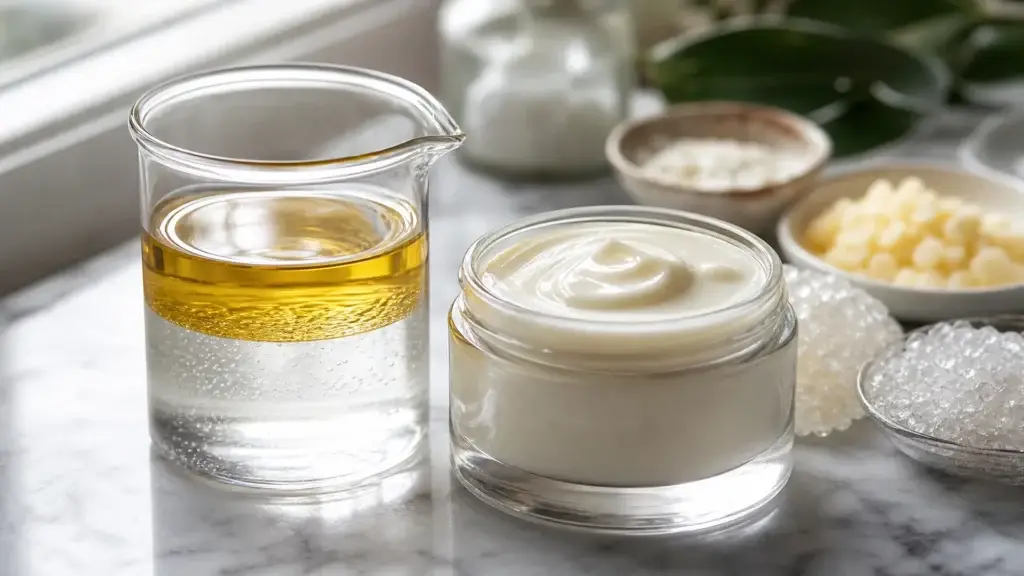
Emulsifier for Natural Creams & Lotions
Choosing the right emulsifier for natural creams is one of the first real decisions you’ll face as a DIY maker, and it’s the one that trips up more beginners than almost anything else. Oil and water simply don’t mix on their own, and without the right emulsifier in the right amount, your beautifully blended lotion will split into an oily puddle within hours. The good news? Once you understand what each emulsifier actually does, picking the right one becomes straightforward. This guide breaks down Olive M1000, Lotion Mulse 65, Emulsifying Wax BP, and cetyl alcohol, what they are, how much to use, and how to troubleshoot when things go wrong.
Why Every Cream Needs an Emulsifier
Oil and water repel each other. Pour a carrier oil into water, stir as hard as you like, and they’ll separate the moment you stop. An emulsifier fixes this: one end of the molecule is attracted to oil, the other to water. It sits at the boundary between the two phases, holds them together, and creates a stable cream.
Without an emulsifier, there is no cream, just two phases waiting to separate. With the wrong emulsifier, or too little of it, you get the same result, just more slowly.
That single principle saves a lot of frustration. Every recipe decision after this, how much emulsifier, which type, when to add it, flows from it.
Types of Emulsifiers (and What Each One Does)
Not all emulsifiers behave the same way. They differ in origin, how they feel on skin, and what kind of emulsion they produce. Here’s how the four most common ones compare.
Plant-Based Wax Emulsifiers: Olive M1000 and Lotion Mulse 65
Olive M1000 (INCI: Cetearyl Olivate & Sorbitan Olivate) is derived entirely from olive oil and is one of the few genuinely plant-derived emulsifiers that produces a stable oil-in-water cream without synthetic surfactants. That makes it a go-to for certified-natural formulations. It produces a soft, skin-identical feel, slightly richer than a standard lotion, and suits facial creams and natural skincare ranges with an eco story. It’s a self-emulsifying wax, so it works as a standalone primary emulsifier.
Lotion Mulse 65 (INCI: Polyglyceryl-3 Distearate & Cetearyl Alcohol & Glyceryl Stearate) takes a different approach. It’s a polyglyceryl-based emulsifier that delivers a noticeably silky, light skin feel, closer to the glide you’d associate with a premium lotion. It’s a strong natural alternative to silicones in creams if you’re reformulating for a lighter texture, and it pairs well with natural alternatives to silicones in creams to create a modern feel without synthetic ingredients. Like Olive M1000, it produces oil-in-water emulsions.
Emulsifying Wax BP and Cetyl Alcohol: What’s the Difference?
Emulsifying Wax BP is a British Pharmacopoeia-grade blend of cetearyl alcohol and a polysorbate-type emulsifier. Its specification is standardised by the BP monograph, which makes it one of the most consistent and beginner-friendly emulsifiers available. Finished creams have a classic, creamy body and bright white appearance, the look most people picture when they think of a body cream. It’s a reliable everyday workhorse and a strong choice for your first formulation.
Cetyl alcohol is frequently misunderstood. Despite the word “alcohol,” it is a fatty alcohol derived from coconut or palm, not a drying solvent. It doesn’t strip or irritate; it thickens and adds slip. At 1–3% it gives a cream a smooth, pearlescent texture and helps stabilise the emulsion. It is a co-emulsifier, not a primary emulsifier. It cannot hold an oil-and-water emulsion together on its own, it always needs a primary emulsifier alongside it.
| Emulsifier | Type | Emulsion | Skin Feel |
|---|---|---|---|
| Olive M1000 | Plant-derived (olive) | Oil-in-water | Rich, skin-identical |
| Lotion Mulse 65 | Polyglyceryl-based | Oil-in-water | Silky, light |
| Emulsifying Wax BP | Cetearyl/polysorbate blend | Oil-in-water | Classic creamy |
| Cetyl Alcohol | Fatty alcohol (co-emulsifier) | Supports o/w | Slip, thickness |
Emulsifier Ratios for Creams: How Much to Use
Getting the ratio right is just as important as choosing the right emulsifier. Too little and the emulsion separates. Too much and the cream feels heavy or waxy.
Usage Rates for Oil-in-Water vs Water-in-Oil Emulsions
Here are the typical working ranges for each:
- Olive M1000: 3–5% of your total formula. Works best when the oil phase is 20–30%.
- Lotion Mulse 65: 3–6%. A lighter oil phase (10–20%) suits its silky finish.
- Emulsifying Wax BP: 4–8%. Higher oil phases (up to 30–35%) need the upper end of that range.
- Cetyl Alcohol (co-emulsifier): 1–3% alongside your primary emulsifier.
A useful rule: the higher your oil phase percentage, the more emulsifier you need to keep everything stable. If your recipe is 25% oils, use more emulsifier than you would for a 15% oil lotion.
Water-in-oil emulsions, where water droplets are suspended in an oil phase rather than the reverse, require different emulsifiers altogether. Ingredients like polyglycerol polyricinoleate (PGPR) or certain lecithin blends are designed for this, and they typically need heavier usage rates of 5–10%. The four emulsifiers covered in this guide are all designed for oil-in-water systems, so if you’re making a rich W/O balm or barrier cream, you’ll need an emulsifier specifically rated for that purpose.
How to Use an Emulsifier in a Cream: Step-by-Step
The method matters as much as the ingredients. This is the standard hot-process approach used in most DIY cream recipes.
Combining Your Oil and Water Phases Correctly
- Prepare your oil phase. Weigh your carrier oils, butters, and emulsifier into one heatproof container. The emulsifier goes into the oil phase, not the water phase.
- Prepare your water phase. Weigh distilled water, hydrosols, glycerin, and any water-soluble ingredients into a second container.
- Heat both phases separately to approximately 70–75 °C. Use a thermometer, this isn’t a step to eyeball.
- Check that both phases are at the same temperature before combining. A 10–15 °C difference between phases is enough to cause separation or graininess. Temperature matching is non-negotiable for a stable emulsion.
- Add the water phase to the oil phase in a slow, steady stream while stirring continuously. Pouring the water into the oil (not the other way around) gives you better control.
- Stir consistently as the mixture cools. A hand blender in short bursts speeds up emulsification.
- Wait until the cream cools below 40 °C before adding heat-sensitive ingredients, fragrance, vitamin C, certain preservatives, and essential oils all go in at this stage.
Once your cream is complete, it contains water, which means it needs a preservative to stay safe. The topic of preserving your homemade cream is a whole subject on its own, but never skip it.
If you want a full worked recipe to follow alongside this guide, the how to make a natural face cream at home walkthrough puts all of these steps into a complete formula.
Troubleshooting: When Your Emulsion Separates or Feels Wrong
Even experienced makers run into problems. Here are the three most common failures and their fixes.
Separation (oil pooling on top or water weeping out)
This almost always comes down to one of two things: not enough emulsifier, or a temperature mismatch when you combined the phases. Check your usage rate against the guidelines above. If the formula looks correct, the culprit is likely a temperature gap between phases. Reheat both to 70–75 °C, bring them to the same temperature, and re-emulsify.
Graininess or a gritty texture
This is most commonly caused by cetyl alcohol (or other fatty alcohols) cooling too quickly. When the mixture cools too fast, these waxy components solidify unevenly and create tiny grains rather than blending smoothly into the cream. The fix is slower, more controlled cooling, keep stirring steadily and don’t rush the cream into the fridge to set.
Heavy, greasy, or draggy skin feel
The oil phase is likely too high, or you’ve chosen a heavier emulsifier than the formula needs. Reduce your oil phase, even dropping from 30% to 20% makes a noticeable difference. Switching from Emulsifying Wax BP to Lotion Mulse 65 can also lighten the skin feel considerably without changing the rest of the formula. If you’re formulating with jojoba oil, its non-greasy profile helps here too, since it absorbs readily and won’t add to a heavy feel.
Choosing the Best Emulsifier for Your Formulation
Here’s a quick decision guide to save you time:
- Light lotion or everyday hydrator → Lotion Mulse 65. Its silky skin feel and lower oil-phase tolerance make it ideal for water-rich, fast-absorbing formulas.
- Natural facial cream with an eco or certified-natural angle → Olive M1000. Plant-derived, skin-compatible, and genuinely effective at lower oil phases.
- Reliable everyday body cream, first formula or a workhorse batch → Emulsifying Wax BP. Consistent, stable, easy to work with, and produces the classic cream texture most customers expect.
- Richer body butter cream or thicker moisturiser → Emulsifying Wax BP as your primary, with cetyl alcohol at 1–3% as a co-emulsifier to add slip and a smoother payoff.
If you’re just getting started and want a wider foundation before diving into emulsifier chemistry, the beginner’s guide to skincare formulation covers the full picture, from phase building to ingredient functions.
DIY Naturally stocks Olive M1000, Lotion Mulse 65, Emulsifying Wax BP, and cetyl alcohol, so South African makers can source a complete emulsifier toolkit in a single order with no import delays. Browse our full range of emulsifiers to find the right one for your next recipe, and if you’re unsure which to start with, reach out or follow along for more formulation guides coming throughout 2026.