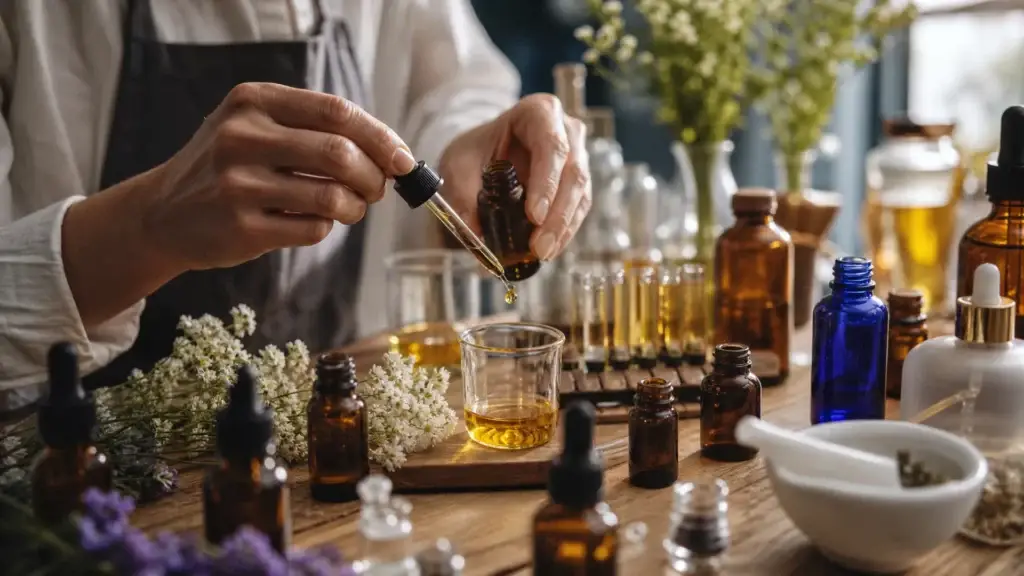
Mixing Perfume With Essential Oils
Mixing perfume with essential oils is one of the most rewarding things you can make at home. You get total creative control over the scent, you know exactly what’s in it, and the result is something genuinely yours, not a mass-produced bottle from a shelf. Commercial fragrances are often built around synthetic aroma chemicals that can be difficult to identify or avoid. With essential oils, what you see on the label is what you get. And once you understand the basic structure of a perfume blend, top notes, middle notes, base notes, and mixing ratios, the whole process becomes far more approachable than it first looks.
Why Mix Perfume with Essential Oils?
Making your own perfume gives you a level of control you simply don’t get from a shop-bought bottle. You choose the ingredients, the intensity, and the character of the scent. If you want something light and citrusy for summer, or deep and grounding for evenings, you can build that from scratch.
There’s also a real cost advantage. A handful of quality essential oils and a basic carrier can yield dozens of individual blends. Compare that to paying a premium for a branded fragrance, and the economics make sense quickly.
Most importantly, it’s achievable. You don’t need a lab, specialist equipment, or a background in chemistry. A few bottles, a carrier, and some patience are enough to get started, especially once you understand how the notes work together.
Mixing Perfume with Essential Oils – Understanding Top Notes, Middle Notes, and Base Notes
Perfume isn’t just a single smell, it unfolds over time. Perfumers organise this unfolding into three tiers, called notes. Each tier has a different role, a different evaporation rate, and a different feel. Understanding them is the foundation of blending well.
Top notes: your perfume’s first impression
Top notes are what you smell the moment you apply a fragrance. They’re the bright, sharp, immediately appealing part of a blend, but they’re also the shortest-lived. Most top notes fade within 30 to 60 minutes as they evaporate quickly from the skin.
Classic top-note essential oils include bergamot, sweet orange, lemon, and grapefruit, citrus oils that open bright but are largely gone within the first hour of wear. Peppermint and eucalyptus also behave as top notes, though they’re more often used in small amounts to add a crisp edge rather than as a centrepiece.
Because top notes disappear fastest, they need the support of the layers beneath them.
Middle notes: the heart of the blend
Middle notes, sometimes called heart notes, are the core of a perfume. They emerge once the top notes begin to fade and carry the main character of the scent for several hours. A well-chosen middle note makes a blend feel rounded and full rather than flat.
Good middle-note essential oils include lavender, geranium, ylang-ylang, rose, clary sage, and chamomile. These are often floral, herbal, or softly spicy, they bridge the brightness of the top with the depth of the base, giving a blend its personality.
Base notes: depth, longevity, and the dry-down
Base notes are the foundation. They’re rich, heavy, and slow to evaporate, which means they anchor the whole blend and give it staying power. The dry-down, the scent left on your skin hours after application, is almost entirely base notes.
Cedarwood, patchouli, sandalwood, vetiver, and frankincense are all strong base-note choices. They tend to be woody, earthy, or resinous. Even a small proportion of a good base note transforms a blend from something pretty-but-fleeting into something that genuinely lingers.
Mixing Ratios: How Much of Each Note to Use
Once you know which oils belong to which tier, the next question is proportion. This is where mixing ratios come in, and it’s simpler than it sounds.
The classic 30-50-20 starting point
A classic perfumery guideline suggests building a blend with roughly 30% top notes, 50% middle notes, and 20% base notes. That ratio creates a balanced arc from first spritz to dry-down. Working with 10 drops total, that’s about 3 drops top, 5 drops middle, and 2 drops base.
This isn’t a rigid formula, it’s a sensible starting point that reflects how the three tiers interact. Middle notes carry the most weight because they define the main character of the scent. Base notes are used sparingly because many are potent; a little goes a long way. Top notes sit in the middle of the ratio, bright enough to make an impression without dominating.
Adjusting the ratio to suit your style
Once you’ve tried the 30-50-20 baseline, you can shift it intentionally. More base note creates a heavier, more sensual fragrance, think evening wear or cooler months. More top note makes the opening brighter and fresher, which suits lighter, daytime blends. Pushing the middle note higher intensifies the heart of the scent and gives more complexity mid-wear.
There’s no wrong answer here. The ratio is a tool, not a rule.
Choosing Your Carrier: Oil, Alcohol, or Wax?
Essential oils are highly concentrated and must be diluted before applying to skin. Understanding the difference between essential oils and carrier oils helps you make the right choice for your format. The carrier you choose also shapes what kind of perfume product you end up with.
Carrier oil (roll-on or body oil style): This is the most beginner-friendly format. A fixed oil like jojoba, fractionated coconut oil, or sweet almond oil dilutes your essential oils and allows skin application. A typical fragrance load for an oil-based perfume is 10–20% essential oil total. Jojoba as a carrier base is particularly popular because it’s stable, non-greasy, and absorbs well without leaving much residue.
Alcohol (eau de parfum spray): Using a perfumer’s alcohol or high-percentage ethanol produces a sprayable fragrance that dries quickly and projects well. Fragrance loads typically run between 15–30% for an eau de parfum strength, or 5–15% for an eau de toilette.
Wax (solid perfume): Solid perfumes, made with beeswax or candelilla wax blended with a carrier oil and essential oils, are a popular low-waste format that makers can produce at home with minimal equipment. Fragrance loads in solid perfumes are usually 10–15%, with the wax providing firm structure and slow, close-to-skin diffusion.
A Simple Step-by-Step Method for Blending
This method works for any format, but roll-ons are the easiest place to start, no specialist equipment needed. Check out essential oil roller bottle blend recipes for inspiration before you begin.
Gather your supplies. You’ll need your chosen essential oils, a carrier oil (jojoba works well), a 10ml roller bottle, and fragrance test strips or plain blotting paper.
Start with your base notes. Add these to your roller bottle or a small glass vial first. Because they’re heavy and slow to evaporate, starting here helps you build from the bottom up.
Add your middle notes. These go in second, on top of the base. Watch your drop count and aim roughly for the 50% middle proportion.
Add your top notes last. These are the most volatile, so adding them last preserves them during the build process.
Test on a strip first. Before applying to skin, place a drop on a test strip and smell it. This gives you a quick first impression without committing the blend to your skin.
Let it rest, maceration matters. Close the bottle and leave the blend to sit for at least 48 hours, ideally a week. During this time the molecules bind and harmonise, and the scent often shifts noticeably. This is the step beginners skip most often, and it makes a real difference.
Adjust and refine. After resting, smell again and decide what’s missing or overpowering. Add drops one at a time and re-test.
A simple starter recipe: 2 drops cedarwood (base) + 5 drops lavender (middle) + 3 drops bergamot (top), topped up with jojoba oil in a 10ml roller bottle. It’s a balanced, wearable everyday blend, fresh, slightly floral, with a grounding woody finish.
Roller bottles and accessories are stocked at DIY Naturally and are one of the most practical beginner formats available, pre-fillable, portable, and ready to use straight away.
4 Additional Blend Ideas
1: Fresh & Green
- Top Notes: Lemon, Basil, Spearmint
- Middle Notes: Green Tea, Neroli, Rosemary
- Base Notes: Vetiver, Cedarwood, Oakmoss
Fragrance Description: A crisp, invigorating scent that feels like a walk through a sunlit herb garden. The citrus and mint sparkle at first, then soften into a leafy, slightly floral heart. The earthy base of vetiver and moss grounds it with a natural, outdoorsy freshness.
Blend 2: Romantic Floral
- Top Notes: Mandarin, Bergamot, Petitgrain
- Middle Notes: Rose, Ylang Ylang, Violet Leaf
- Base Notes: Amber, Benzoin, Sandalwood
Fragrance Description: Soft, luminous, and romantic. The citrus opening is delicate and uplifting, leading into a lush bouquet of rose and ylang ylang. The base adds warmth and sensuality with amber and sandalwood, creating a timeless floral perfume.
Blend 3: Spicy Oriental
- Top Notes: Cardamom, Black Pepper, Sweet Orange
- Middle Notes: Clove, Cinnamon, Jasmine
- Base Notes: Frankincense, Myrrh, Vanilla
Fragrance Description: Rich, exotic, and mysterious. The spicy top notes immediately intrigue, while the floral‑spice heart adds depth and complexity. The resinous base of frankincense and myrrh, softened by vanilla, leaves a smoky, sensual trail.
Blend 4: Woody Masculine
- Top Notes: Bergamot, Lime, Juniper Berry
- Middle Notes: Cypress, Sage, Lavender
- Base Notes: Sandalwood, Patchouli, Leather (accord)
Fragrance Description: Clean, bold, and grounding. The citrus‑juniper opening feels sharp and refreshing, balanced by herbal middle notes. The woody base with patchouli and leather creates a strong, confident finish — perfect for a more masculine profile.
Tips for Troubleshooting and Refining Your Blend
Even experienced blenders make adjustments constantly. If your first blend doesn’t land perfectly, that’s normal, here’s where most beginners go wrong and how to fix it.
Using too many oils at once. It’s tempting to reach for eight or ten different oils, but this creates muddy, confusing blends that are hard to troubleshoot. Start with three to five oils, nail the balance, then expand.
Skipping the resting period. A blend smells different, often significantly so, after 48–72 hours of maceration. Judging a fresh-mixed blend is like tasting raw cake batter instead of the finished bake. Wait before you decide it’s not working.
Over-applying. Oil-based perfumes are more concentrated than sprays and diffuse more slowly. A light application along pulse points, wrists, inner elbow, neck, is enough.
Not patch-testing. Some essential oils can cause skin sensitivity, especially if your ratio is on the higher end. Always do a patch test on a small area of skin and wait 24 hours before wearing a new blend all day.
Not keeping notes. Write down every blend you make, drops, oils, ratios, and what you thought of it. Without notes, you can’t recreate a success or understand what went wrong.
Blending is a skill that improves with each attempt. The more you experiment, the more intuitive the note tiers and mixing ratios become. If you’re ready to begin, DIY Naturally has a selection of essential oils including a selection of Doterra essential oils available. Remember to add a bottle of jojoba, and a pack of roller bottles to your cart as well, this is all you need to get your first blend on your wrist. Start simple, trust the process, and adjust from there, that’s how every good perfumer works.
If you’re new to making things at home more broadly, the beginner’s guide to DIY formulation is a useful place to build your foundational knowledge alongside perfume blending.
Disclaimer: All recipes and formulas are shared in good faith. DIY Naturally is not liable for any adverse reactions. Always perform a patch test before use, and substitute ingredients if you have known allergies. Use at your own discretion.